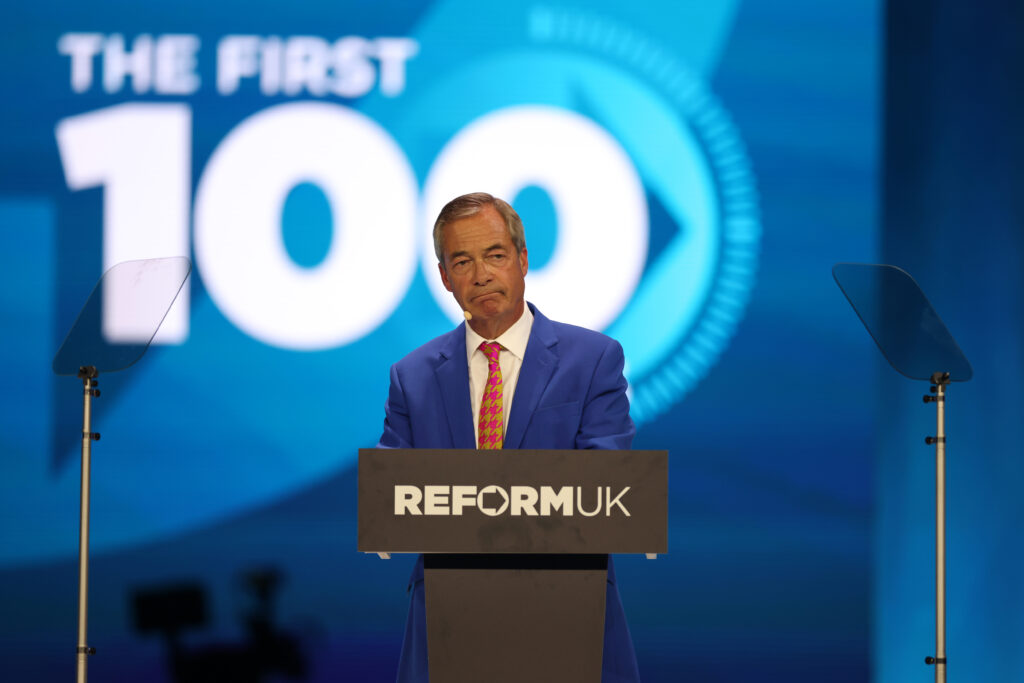
Reform have capitalised on the revival of Christianity in the UK, and many wonder whether it is the beginning of a bigger shift (Photo by Peter Macdiarmid/Getty Images)
Following from Eastern Sunday, religion - and particularly Christianity - seems to be regaining relevance in the British political scene. But will it transform British politics as we know it?
There was once a time wherein religion was not merely an accessory to British politics, but actually was British politics. The Church of England, famously labeled as the Tory Party at prayer, sat at the very centre of the political system. Faith was not simply a lifestyle choice. Yet, this has changed. By 2021, fewer than half of people in England and Wales identified as Christian for the first time since records began. Indeed, Tony Blair once famously said, “We don’t do God.” It seems, now, as though he was talking on behalf of the country.
Yet despite this, a realignment appears to be occurring, albeit very slowly and in the background. The Unite the Kingdom rally of September 2025, which drew somewhere between 110,000 and 150,000 people through central London, was swathed in Christian symbolism. Some marchers carried wooden crosses. Some banners declared, “Jesus is King” and one social media clip was titled, “The Christian Revolution is Now.” The proceedings opened with a prayer, with the individual leading it claiming it was his “Christian duty” to do so.
Clearly, Christianity was not in the background of this rally - it was front and centre. Following this, Reform UK launched its Christians for Reform fellowship, with Sarah Pochin declaring that Britain is "fundamentally a Christian country." The Spectator, writing just days ago, argued that religion will play a pivotal role in the next general election - that Britain's politics is "back doing God again."
It may appear on the surface, therefore, that Britain is undergoing some type of religious revival. That, after years of faithlessness, the British people have returned to their roots. But such a perspective should be taken with a great degree of scepticism.
"What is happening is not a spiritual awakening per se"
What is happening is not a spiritual awakening per se. One attendee at Unite the Kingdom, describing herself as "not especially religious," told a reporter the event was about "tradition and cohesion." Another spoke of feeling that "the national Church doesn't include them anymore." These are not the words of the devout. They are the words of people using Christianity as a proxy for something else. Perhaps for a sense of belonging, cultural comradery, and grievance against what they perceive as the erasure of a particular version of Englishness. The cross on the banner has become a cultural symbol, not a devotional one - even if there exists those that say otherwise.
When Farage speaks of how what, “underpins everything is our Judeo-Christian culture" he is not making a theological claim. He is making a claim rooted in identity. Christianity, in this sense, acts not as a sign of virtue, but as a founding principle of western civilization, and thus, by extension, western identity.
That is not to say that it is wrong to argue that religion will play a pivotal role in the next general election. In fact, the opposite is true. The mobilisation of Muslim voters, most visibly in the Gorton and Denton by-election, is real. Christians for Reform is also real. But the idea that Britain is about to mirror the United States and develop some type of evangelised, Christian bloc does not match up with reality.
America's religious right is built on decades of institutional infrastructure, be these megachurches or legal advocacy networks. Britain, on the other hand, lacks such infrastructure. Its churches are crumbling - both metaphorically and literally. The fundamental separation between Church and State acts as a type of guardrail, that makes it incredibly difficult to interweave the two.
Britain is thus not retreating to the type of religious fever that once captivated it centuries ago. It is reaching for the symbols of religion as a substitute for the thing itself. To fill a vacuum of identity that nothing has been able to. Christianity in the UK has morphed into a sense of belonging. There is nothing inherently wrong with this, of course. But when asking the question of whether religion is seeping into British politics, it is an essential note to point out....
Subscribe to The Mace
Join the member community shaping British politics and stay ahead of
what's really happening in the world of politics and public affairs,
with expert analysis, breaking news, and insider insights from
Westminster and Brussels. The Mace is the leading news source and
resource for the government affairs industry, offering required
reading and lobby intelligence for professionals.
To see what you are missing out on by not subscribing to The Mace, click here to download our full membership info-pack. This includes
having no paywall on op-ed content or profiles/interviews, allowing
professional profiles to be read with maximum impact and visibility by
government, special advisers, MPs, peers, civil servants, and policy
and political decision-makers.
The Civil Service is ready to support Dame Antonia Romeo's flagship changes to government machinery - notably relating to AI and devolution - under new prime minister Andy
Andy Burnham is shaking up government with more changes than by any incoming prime minister in memory. But, asks Sir Bernard Jenkin MP, does he understand why the
UK aviation can decarbonise while meeting growth ambitions, but urgent government action is needed to prevent costs increasing for passengers and the sector losing its competitive edge.
The news that former Home Secretary Sir Grant Shapps has failed to make the new Tory candidate list has put fear into dozens of former Conservative MPs. Whether
Cameron Brown, a former special advisor to the Chancellor of the Exchequer, explains why Burnham's VAT cut on energy bills is a measure people will actually notice.
The strangely guilty way that the media, and some politicians have reacted to Widdecombe’s shocking death shows the double standards that can operate when a politician of the
James Purnell’s return to frontline politics is more than a nostalgic Blair-Brown era reunion. As Andy Burnham builds his Downing Street operation, public affairs professionals will need to