Can Viktor Orbán be defeated? 

François Valentin and Jorge González-Gallarza | 11th February 2022 | Brussels, International
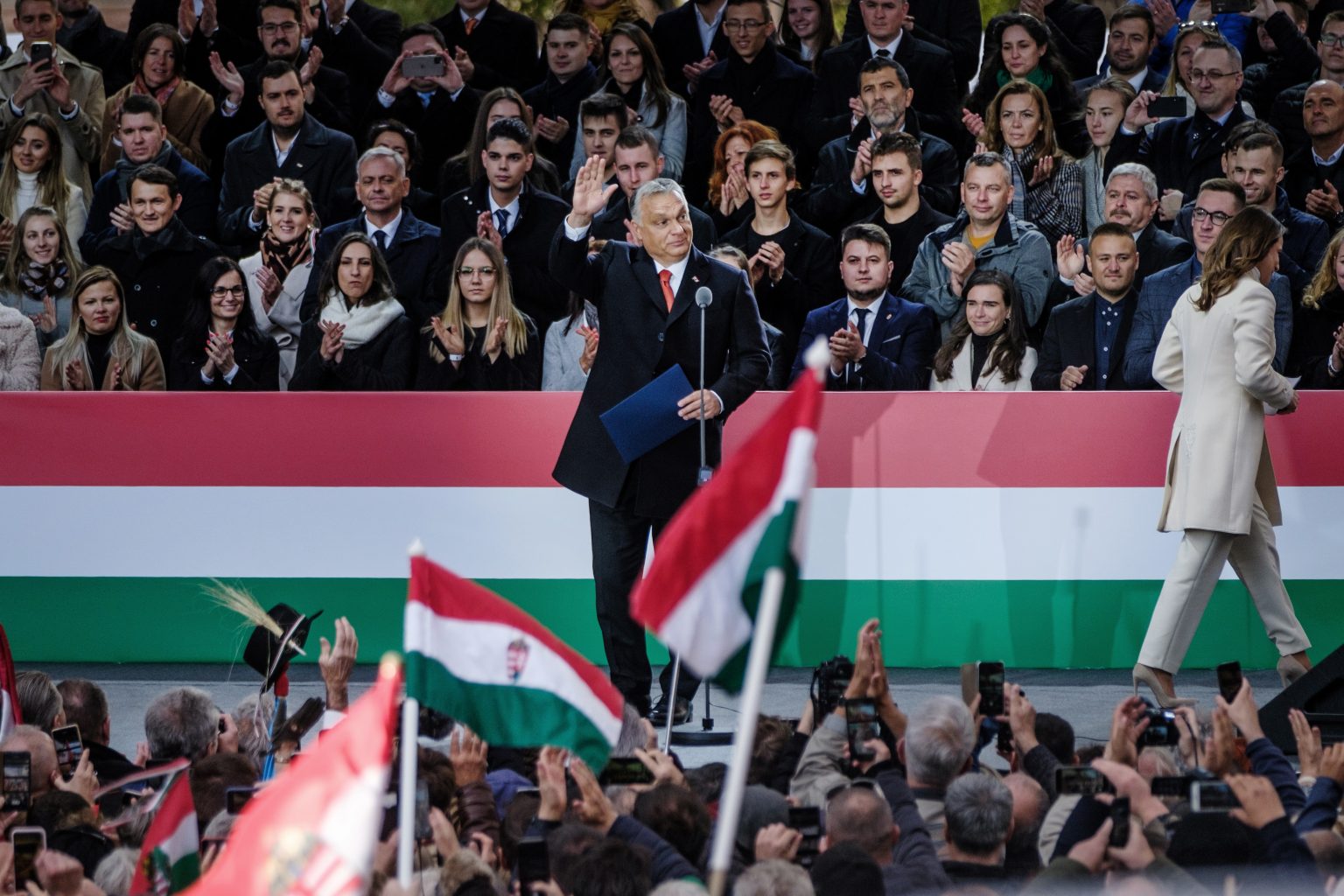
BUDAPEST, HUNGARY - OCTOBER 23: Viktor Orban, Hungary's prime minister delivers his speech during a peace march on October 23, 2021 in Budapest, Hungary. The new Hungarian opposition leader Peter Marki-Zay, the surprise winner of the primaries, intends to shake up the political scene to overthrow Hungary's President Viktor Orban of the Fidesz party in April 2022 during presidential elections. (Photo by Janos Kummer/Getty Images)

Hungary’s opposition seems united around little more than its dislike of the PM and his Fidesz party. Will that be enough to beat him in April's elections? 

When exactly are electoral observation missions warranted in a democracy? Hungarians are heading to the polls on 3 April to elect a new parliament and a substantial share of the opposition to Prime Minister Viktor Orbán seems to fear that the election will be neither free nor fair. Late last month, a coalition of MEPs from 19 different countries and five different political groups officially requested a team of election monitors from the Organization for Security and Co-operation in Europe (OSCE). The multilateral body quickly acquiesced. Their call for applications, should you fancy enlisting in their mission to monitor fraud and ensure equal access to balloting, is open until until the end of today (11 February). Despite agreeing on little else, Dalibor Roháč and Boris Kálnoky both seemed confident that these legislative elections actually will be held in 'acceptably' fair terms. Ultimately, by throwing the election results into doubt, the opposition is making a larger point about the direction Hungary is headed in. Orbán returned to office in 2010 after Hungary had experienced a decade of economic mismanagement under his party's socialist rivals. According to his critics, he has been amassing power at the expense of democratic institutions, silencing critical media, lining the pockets of his Fidesz-affiliated cronies, and advancing an illiberal worldview that threatens Hungary’s good standing in the European Union (EU), as well as the rights of minorities at home. In EU-talk, the sum total of these concerns is often referred to by the phrase “democratic backsliding”, also used to label Hungary’s two closest allies, Poland and Slovenia.  But that is only one side of the story. For his supporters, the bad press Orbán gets in Brussels and other European capitals is part of a well-orchestrated, ideologically-fuelled campaign against any country or politician who dares oppose the EU’s liberal-federalist consensus. It is, this group cry, a witch hunt of sorts against right-wing wrongthink. Regardless of the result on 3 April, one of the Orbán government’s more interesting legacies will doubtless have been the promotion of a conservative counterculture through institutions such as Mathias Corvinus Collegium (MCC), which it endowed with no less than €1.7 billion, and where Boris Kálnoky teaches journalism. A slew of American right-wing stars including Rod Dreher, Sohrab Ahmari and Tucker Carlson has been making frequent visits to Budapest. A good example of the ideological culture war dividing Hungary’s society and colouring its perception abroad is a referendum on including LGBT content in school curricula, to be held the same day as the election. For Orbán’s camp, banning depictions of homosexuality from textbooks aimed at pre-pubic children is a matter of upholding decent mores, whilst his left-liberal opposition has lambasted what it deems to be a bigoted campaign to stigmatise homosexuality.  Given Hungary’s rather conservative electorate, relative to Western Europe, the opposition would be better advised to push aside the argument that such a law is a violation of the liberal orthodoxy and instead publicise the threat to the country’s access of vital EU funds. Though it has elsewhere pledged not to interfere in domestic matters, the European Court of Justice (ECJ) upheld, in a ruling issued last December, the legality of the so-called conditionality mechanism, a legal tool that has allowed the European Commission to pare back parts of Hungary’s allotted share of the EU’s Covid-19 recovery fund—around €7 billion—on the grounds that Orbán’s minimal progress combating corruption endangers “rule of law”. An even better trump card to play during the campaign would be pointing to Orbán’s foreign policy. A conservative himself, Roháč expressed concern that Orbán may be turning Hungary into a gateway into Central Europe for nefarious actors. Last summer, Hungary allowed Fudan University to open a campus in Budapest despite concerns that China uses these educational ventures for industrial espionage. Putin’s Russia has similarly found an ally in Hungary, a large buyer of its gas and the location of several Russian-operated nuclear power plants. For Kálnoky, lecturing Hungary on what its foreign policy should be betrays the same self-sufficient smugness that Western liberals adopt towards the country’s conservative mores, especially when bigger players in the EU such as Germany have also developed equally deep ties with both Russia and China over recent years.  These are merely a few glimpses into the kind of negative cases the opposition is likely to campaign on. But what do these groups stand for exactly? Well, it’s hard to tell. The spectrum of forces united behind Péter-Márki Zay, Orbán’s main challenger, ranges widely, from the right-wing Jobbik party to the liberal progressives of Momentum. Zay himself is a Catholic father of six and a former Fidesz voter who has been careful to keep the more radical elemen...

Subscribe to The Mace

Join the member community shaping British politics and stay ahead of what's really happening in the world of politics and public affairs, with expert analysis, breaking news, and insider insights from Westminster and Brussels. The Mace is the leading news source and resource for the government affairs industry, offering required reading and lobby intelligence for professionals.

To see what you are missing out on by not subscribing to The Mace, click here to download our full membership info-pack. This includes having no paywall on op-ed content or profiles/interviews, allowing professional profiles to be read with maximum impact and visibility by government, special advisers, MPs, peers, civil servants, and policy and political decision-makers.

Merkel’s Legacy is in Tatters

Azeem Ibrahim OBE | June 30, 2026

How Angela Merkel Weakened the West and Handed Putin and Xi Leverage

‘Never bet against America’ SpaceX debut makes millions for the UK  

Lucy Carrier-Pilkington | June 16, 2026

The most highly anticipated stock market debut of the year, perhaps of all time, has delivered a huge win for UK investors.

Brussels Diary by Konstantinos Bogdanos: ‘The local bistros are half-empty as the Belgian middle class finds even a weekend meal an unaffordable luxury”

Konstantinos Bogdanos | May 26, 2026

Konstantinos Bogdanos, our regular Brussels Diarist, on how the bills for Europe’s political class are finally coming due in a city where the Belgian middle-class can't afford to

Are Labour eyeing a return to the EU? Mace investigates the key players involved 

Lucy Carrier-Pilkington | May 19, 2026

Recent comments by the former health secretary have plunged Brexit back into national conversation, but what does Labour actually think?

EU likely to shelve chemical reform amid industry pressure 

Lucy Carrier-Pilkington | May 6, 2026

The reform concerns a pre-existing law on the Regulation, Authorisation and Restriction of Chemicals (REACH) and has been in place since June 2007.  

King Charles: The real ‘special ingredient’ in our relationship with the USA 

Lucy Carrier-Pilkington | April 29, 2026

King Charles’s address to Congress was designed to steady a strained special relationship. Twelve standing ovations later, the Palace had given Downing Street something politics could not: a

Maritime trade bodies warn of citizens being caught in Iranian crossfire

Oliver Dean | March 12, 2026

As the Iranian conflict continues, maritime trade bodies have warned of the significant loss of human life thus far.

Britain faces a crisis of statecraft – not power.

Azeem Ibrahim OBE | March 9, 2026

Despite being criticised for its dwindling position on the world stage, Britain is not lacking in power. What it really needs is statesmanship.

US defence industry launches lobbying offensive against EU’s ‘Buy European’ push

Oliver Dean | February 20, 2026

As European policymakers push a 'Buy European' line, lobbyists and officials in Washington are keen to maintain dominance over the European arms market

Aviation trade bodies warn of four-hour queues unless changes are made

Mace | February 12, 2026

Trade bodies warn that biometric entry requirements will lead to massive delays for travellers