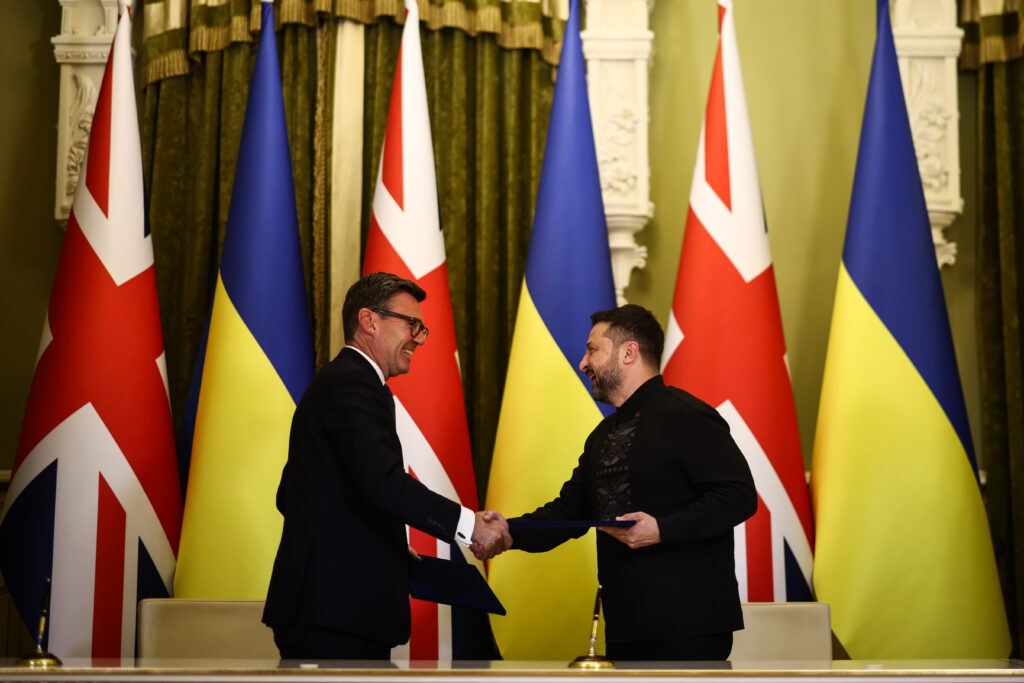
Andy Burnham has promised to keep the pressure on Russia despite Moscow’s “outrageous threats”, on his first official overseas visit to Ukraine as Prime Minister.
Burnham met with Ukrainian President, Volodymyr Zelensky, and chaired his first meeting of the “coalition of the willing” set up by the UK and France.
The coalition could prove significant beyond the immediate war in Ukraine. The depth of the relationship between the US and Europe has become a source of unease for many countries, and Trump’s willingness to abandon Ukraine to accommodate Russia has further impacted this.
The coalition could represent an attempt by European powers to ensure they are capable of defending European security even if US backing becomes less certain. While Europe isn’t necessarily trying to replace America, it may be preparing for a future in which it cannot assume that America will always be doing the heavy lifting. For Britain, its leading role in the coalition also presents the opportunity to reinforce its position as a major European security power despite no longer being part of the European Union.
During the visit, which came on Ukraine’s 35th Independence Day, Burnham announced that his government will share the blueprints of Britain’s long-range Scalp missile, allowing Ukraine to produce the weapon domestically. The missile is capable of hitting targets around 150m into Russia. While it falls short of Ukraine’s deep-strike drone capability, it nevertheless represents a significant step in demonstrating the willingness of international partners to share both weapons and technology.
“Ukraine has been Europe’s protector, not a drain on our security but the frontline in keeping Europe safe.”
The former head of MI6, Richard Moore, said that Britain handing over the blueprints was “a very important signal” to give Ukraine.
Burnham, in his first major speech on the international stage, said: “Despite Russia’s outrageous threats to my country we will continue our support for Ukraine.
“This is the moment to keep the pressure on Russia, the moment to squeeze their ability to fund this illegal war.
“Ukraine has been Europe’s protector, not a drain on our security but the frontline in keeping Europe safe.
“The Ukrainian people deserve not just our continued support but our gratitude and respect.”
This comes after Kremlin spokesman Dmitry Peskov criticised the UK, stating the UK is “participating in this war” on Ukraine’s side.
He said: “Britain is methodically and regularly adding fuel to the fire and methodically and regularly plotting to prevent any progress in the peace process.”
Moscow’s accusations highlight the increasing blurred lines between supporting a country at war and participating by becoming directly involved in its conflict. While Britian maintains that its support is defensive and designed to enable Ukraine to defend itself, Russia increasingly frames military assistance as direct participation. The danger for Burnham lies in the balancing act. The more Britain moves towards sharing technology and developing long-term military capabilities with Ukraine, the harder it becomes to separate support for Kyiv from a wider strategic confrontation with Moscow.
Peskov also told reporters that the Russian military was already gathering evidence to locate missile production sites and destroy them.
Burnham hit back saying: “Who started the fire? That’s the question.”
Downing Street has also said that the UK’s support for Ukraine had not changed despite the Russian threats of retaliation.
“I think we’ve always been very clear about how we feel about Russia’s barbaric actions. We have consistently said that across the last four years and nothing has changed in that regard.”
In a speech marking Ukraine’s 35th Independence Day, Zelensky said: “Ukrainians will not be cobblestones under the feet of tsars and rulers. Ukrainians will not submit.”
During the event in front of Saint Sophia Cathedral in Kyiv, Burnham also accepted an award from Zelensky on behalf of the British people, recognising the UK’s support for Ukraine.
Ukraine being Burnham’s first international trip as the Prime Minister is not an accident but rather reaffirming to both the people of Ukraine and the UK that he intends to continue down the path that the UK had been forging in the years before his premiership. The decision to share the missile blueprints takes this commitment further, positioning Britain as a key player in the development of Ukraine’s long term military capability. It also reinforces Britain’s role at the centre of European security at a time when reliance on the US becomes increasingly uncertain.
Burnham appears to be signalling that Britain’s approach to European security will remain centred on supporting Ukraine.