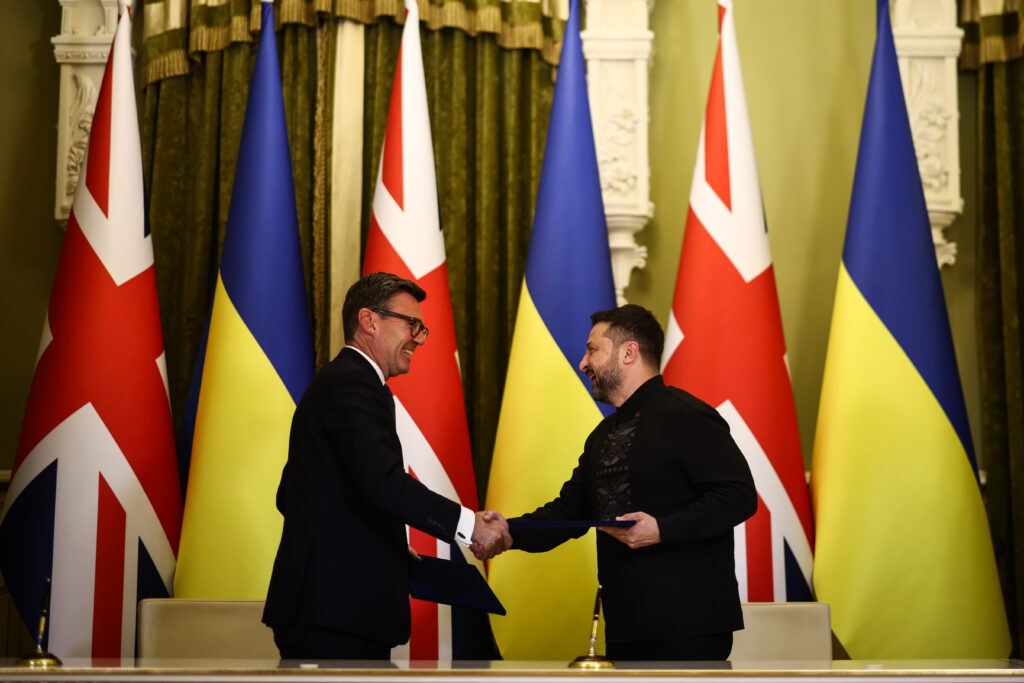
Burnham went to Kyiv. Now comes the harder journey to Washington
The Prime Minister’s first foreign visit was a welcome act of solidarity. But for Ukraine, British friendship will be judged by whether it can help unlock the air


After walking through Saxony, James Jeffrey is not surprised by the AfD’s dramatic election win in Germany.
Alternative für Deutschland (Alternative for Deutschland), whose political orientation among media descriptions includes “hard-right”, “far-right” and “extreme-right”, achieved just under 44 per cent of the vote, more than doubling its share from the 2021 state election.
The Christian Democratic Union (CDU), the party of chancellor Friedrich Merz that won the state in 2021, lost 20 per cent as its share fell to 17.2 per cent. The speed with with AfD has ascended to where it is now, since emerging in 2013 – when it polled under 5 per cent – poised to win other state elections and perhaps even achieve the once unthinkable and win Germany’s next federal election in 2029, highlights the level of discontent in Germany that I encountered in 2025 when I walked across the breadth of the country in a role that developed into pilgrim-journalist.
The Federal Republic of Germany comprises16 Bundesländer states. To reach the French border from Berlin, I passed through six of those states, including Saxony-Anhalt, or Sachsen-Anhalt, to use its proper German name.
In Saxony-Anhalt it appeared pretty clear to me that the AfD were in the ascendant and heading for regional government there – and I can’t say that fact detracted from my time there. The relatively rural and sparsely populated region of around 2.1 million people offered a slower pace of life and a sense of cohesive tradition and Germanic-ness that I fondly recognised from the Germany I spent much of my youth in during the 1980s and 1990s as a “camp follower” of the British Army of the Rhine (BAOR).
The majority of Saxony-Anhalt locals I met were friendly and enthused about my travels through their land. They also often weren’t shy – especially after a few local beers – of expressing their concerns about the state of the country and of the fact they supported the AfD over all the other options that, they deemed, were failing miserably.
Immigration was the key issue I repeatedly heard mentioned, in particular the 2015 decision by Angela Merkel to open Germany’s borders to those fleeing the Syrian Civil War. During the subsequent decade, it’s estimated more than 3 million migrants came to Germany, including about 1.2 million during the migration peak of 2015 and 2016, followed by 1 million from Ukraine after Russia’s invasion.
Combined with previous migration trends – such as the influx of Turks during the1960s’ Gastarbeiter (guest worker) program to address Germany’s labour shortages during its economic boom – it means the proportion of Germany’s population with an immigrant background, including second-generation immigrants, is estimated at 25 million, representing about 30 per cent of the population.
That can only have an impact on how the Germany of today looks and feels – on the zeitgeist, to use that thoughtful German word – and as I saw so clearly evidenced during my travels.
Migrants can’t be blamed for building businesses and families once they have been taken in – they usually deserve credit for what they have overcome and achieved. But it has also resulted in what often appears the Islamification of Germany, especially when the language dominating a city centre is Arabic and not German.
Hence it was hard not to sympathise with the concerns of Saxony-Anhalt locals who lamented how larger towns and cities no longer offer any sense of community, replaced instead by economic pressures and competitiveness. Similarly, it’s hard not to conclude that ordinary Germans have been left little choice by their flailing political system.
“The Sachsen-Anhalt election [turned] into a vote on the integrity and viability of the political system,” Christopher Caldwell writes in First Things. “The last two decades have seen a succession of crises that have both worsened Germany’s prospects and reduced its autonomy – instability in the euro, uncontrollable immigration, COVID, war in Ukraine, a collapsing industrial model, and an increasingly unpredictable American protector.
“The AfD has risen to prominence because of these crises. Suspicion has arisen across society that the established parties are ill-equipped to deal with the country’s largest problems, and, worse, refuse to be frank and honest about them.”
Based on conversations I had in Saxony-Anhalt and across the five other Bundesländer, it is Caldwell’s last point that has most riled so many Germans (just as it is riling so many Brits regarding their political system): people feel established parties are refusing to be frank and honest.
Yet the established parties continue in the same vein and appear utterly unwilling to do or say anything differently to assuage such suspicions. As a result, the AfD, having formerly been limited to a foothold in the states – like Saxony-Anhalt – of former East Germany, is now pulling away at the federal level. About 28 percent of German voters say they would vote for AfD in the next national election, ahead of the 21 per cent who say they would would vote for the CDU.
It appears similar to the situation the US faced in 2024, with either pivoting to Donald Trump again or continuing with the increasingly woke and out-of-touch Democrats.
Many US voters, despite concerns about Trump, felt the Democrats were failing and so, holding their noses, voted for Trump. Now that we are nearly two years into Trump’s second term, that should give us pause regarding Saxony-Anhalt and the rising AfD: Trump’s second term has shown the authoritarian tendencies his critics warned about.
So we shouldn’t underestimate the more extreme elements contained in the AfD, such as its strict ethnic conception of German citizenship and promise of “re-migration” – potentially mass deportation – and where that all might take the country were the AfD to gain power at national level. Caldwell describes the AfD’s “preoccupations” as a mix of “straightforwardly conservative” ones and “genuinely disruptive and radical” ones.
Despite such concerns, it’s hard to blame those Saxony-Anhalt voters who decided to give this untested party the benefit of the doubt in the hope of saving a fracturing Germany.
The Prime Minister’s first foreign visit was a welcome act of solidarity. But for Ukraine, British friendship will be judged by whether it can help unlock the air
Andy Burnham has promised to keep the pressure on Russia despite Moscow’s “outrageous threats”, on his first official overseas visit to Ukraine as Prime Minister.

Andriy Dovbenko is a Ukrainian-born, London-based entrepreneur who works extensively across the UK and Ukrainian defence.
A former politician who held a number of senior roles in the UK Parliament over a decade, Brooks is now Founder and Chairman of Trypillian, a British-Ukrainian defence

How Angela Merkel Weakened the West and Handed Putin and Xi Leverage

The most highly anticipated stock market debut of the year, perhaps of all time, has delivered a huge win for UK investors.

The reform concerns a pre-existing law on the Regulation, Authorisation and Restriction of Chemicals (REACH) and has been in place since June 2007.

King Charles’s address to Congress was designed to steady a strained special relationship. Twelve standing ovations later, the Palace had given Downing Street something politics could not: a

As the Iranian conflict continues, maritime trade bodies have warned of the significant loss of human life thus far.

Despite being criticised for its dwindling position on the world stage, Britain is not lacking in power. What it really needs is statesmanship.
