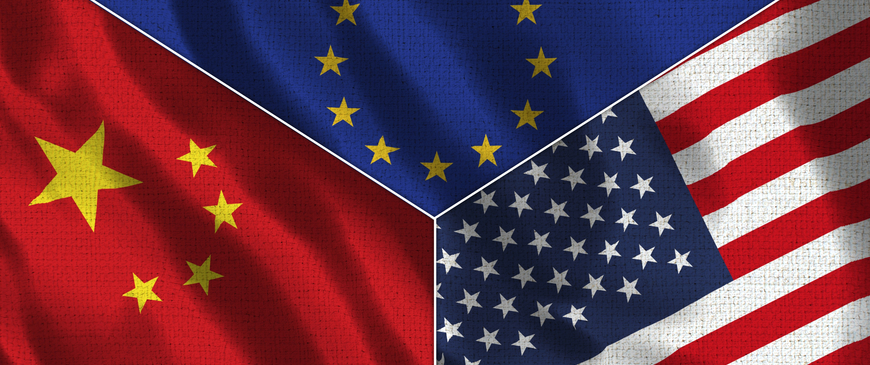
It’s been a long time coming, and now it’s official. Dubbed as a new Cold War, the US-China confrontation in the Pacific has now cut across the Atlantic into the NATO Summit Declaration. Yet, in a re-emerging bipolarity, Europe may this time choose to play the role of a third pole of power, writes Dr Antonios Nestoras.
NATO shifts for a New Cold War
In December 2018, for the first time in its history, China got a mention in a closing statement of a NATO leader’s Summit which declared the country presented “both opportunities and challenges”. Fast forward to less than three years later and the difference in language is striking: a few weeks ago in Brussels, NATO leaders blasted China’s “ambitions and assertive behaviour” as “systemic challenges to the rules-based international order and to areas relevant to Alliance security”.
This is a historic shift that concludes the latest episode in a period of deteriorating US-China relations. What preceded the Brussels Communiqué was a series of protectionist measures on both sides, such as Trump’s Huawei ban (May 2019) and Xi’s announcement of a “dual-circulation policy” (May 2020), which were heralded by media pundits and analysts as the beginning of a US-China Cold War.
Despite efforts to dampen the protectionist drive and normalise relations, the rivalry has instead intensified, entangling more states in a situation that is starting to resemble what Niall Ferguson called a “tech world war”.
The Americans are looking to leverage NATO and draw their European allies into the US-China rivalry - so the latest leaders’ statement can also be seen as an attempt to redefine NATO’s mission in a new Cold War. This time, though, they’re confronting a different adversary. Although the situation invokes historical analogies with the US-Soviet Cold War, many things are similar, but some things are vastly different – especially when it comes to Europe’s ability to play an autonomous role in the conflict.
The Inevitable Conflict
Their country’s superpower rivalry with China has been long in the making - according to many American academic and policy-making circles, who have been watching the ascent of China as an economic powerhouse, its assertiveness in challenging US interests in the Asia Pacific, and its ambition to revise the US-led liberal order.
In addition to geopolitical dynamics, Charles Edel and Hal Brands writing for Foreign Policy concluded that the origins of the US-China Cold War were also ideological. According to them, an authoritarian regime such as China could never feel domestically secure whilst the international community remains overwhelmingly liberal democratic. Thus, an intense political hostility between the US and China - to some - has a sense of inevitability.
American thinking about the new superpower showdown is inevitably influenced by historical comparisons with the US-Soviet Cold War. Michael McFaul, Professor of International Studies at Stanford University, notes that even though China is not calling for a global revolution like the Soviets did, but equally, China is more integrated with the liberal world order than the Soviets were just as the US are more interdependent with China than they ever were with the Soviets. McFaul subsequently suggests that China will be a far more challenging foe to the US than Soviet Russia.
Where is Europe in All This?
Europe is not the same continent it was 70 years ago; its position in a New Cold War will thus differ to its one in the last. In 1945, Europe’s economy was wrecked and it was totally dependent on US aid for recovery. Today, the joint economy of the bloc ranks third in the world - both in nominal terms and purchasing power parity. The internal market of the 27 member states now guarantees the free movement of goods, services, capital and labour, whereas the EU relies on free trade agreements to bolster Europe’s economic weight and influence in the world. The Euro, used by 19 of the member states, is the second largest reserve and second most traded, after the US Dollar.
For decades following the aftermath of World War II, the continent was fragmented: Germany was divided in two and occupied by allied forces and the Red Army; Eastern European states were in the Soviet sphere of influence, run by puppet communist regimes; most European countries did not have a functioning liberal democracy (Greece, Spain and Portugal, for example, were not democratised until the 1970s).
Today, the process of European integration has created not only an economic bloc, but also a political union, which - despite its problems - is increasingly conscious of its own history, values and weight in international affairs.
The grievous destruction of the war, the undoing of colonialism and dependency on the US for security did not leave the ailing European states with much room for exerting international influence. EU diplomacy was difficult from the beginning due to its specific nature and consuming battles for internal legitimacy and consensus amongst the member states - the 2016 EU Global Strategy has been called an “exercise of diplomacy in its own right”. For the most part, the second half of the twentieth century was a great period of introspection for Europe.
This is changing fast. On the one hand, continent...
Subscribe to The Mace
Join the member community shaping British politics and stay ahead of
what's really happening in the world of politics and public affairs,
with expert analysis, breaking news, and insider insights from
Westminster and Brussels. The Mace is the leading news source and
resource for the government affairs industry, offering required
reading and lobby intelligence for professionals.
To see what you are missing out on by not subscribing to The Mace, click here to download our full membership info-pack. This includes
having no paywall on op-ed content or profiles/interviews, allowing
professional profiles to be read with maximum impact and visibility by
government, special advisers, MPs, peers, civil servants, and policy
and political decision-makers.
The news that former Home Secretary Sir Grant Shapps has failed to make the new Tory candidate list has put fear into dozens of former Conservative MPs. Whether
Blakeney has welcomed former drinks company Oatly managing director Tim Knight and pro-Brexit MEP Lucy Harris, in an effort to strengthen their position, the public affairs and strategic
Benjamin Wegg-Prosser, who co-founded the lobbying firm Global Counsel alongside Peter Mandelson has today resigned following significant backlash regarding the firm’s link to Jeffrey Epstein.
The Russell Group has picked Professor Libby Hackett, an Australia based public policy specialist, as its next chief executive, handing the UK’s most influential research university lobby to