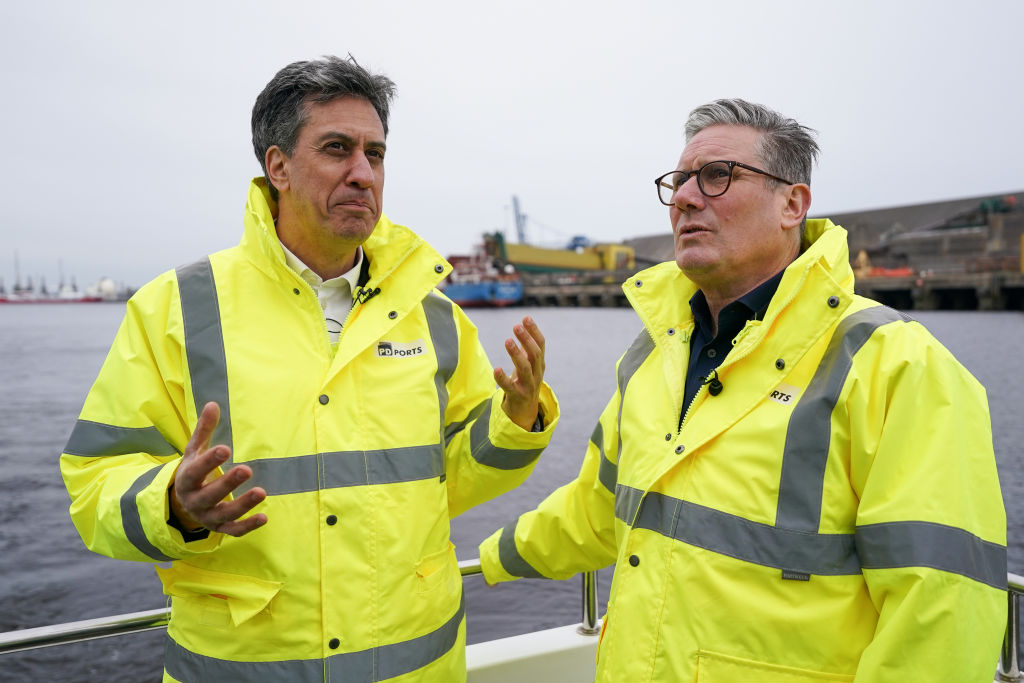
Ed Milliband is LabourList's most popular Cabinet member (Photo by Ian Forsyth/Getty Images)
With Ed Milliband poised to be one of the favourites to succeed Starmer as Prime Minister, we must remember what a Milliband premiership would look like, writes Ted Newson
A recent poll by LabourList found that Ed Miliband is by far the Labour Party membership’s favourite Cabinet Minister. While this reflects the tendency among party members to amplify its more activist wing, it also sits uneasy with wider economic pressures. The party’s most committed advocate of rapid decarbonisation has already pushed energy bills higher through overly ambitious Clean Power 2030 commitments. If he were to run the country, he could raise the cost of living just as sharply.
Recently, the number of U-turns from the government has been politically awkward for Keir Starmer. From reversing plans to hold elections in May to the mishandling of Peter Mandelson’s appointment, having the acquiesce and release his vetting files, the Labour Party’s current trajectory appears unstable. Advisors, senior civil servants, and party officials have taken the wrap for previous mistakes by Starmer, just how long can his position as the PM remain tenable?
It is therefore plausible that a senior Labour figure could mount a leadership challenge amid perceptions of strategic drift at the top of the party. While the PM may be sinking, a government driven by a strong radical left vision could be much more destabilising for the British economy.
"It is therefore plausible that a senior Labour figure could mount a leadership challenge"
Ed Miliband is one such figure, clearly positioned on the left of the Labour Party. As a modern Fabian, he embodies the tradition of gradualist state activism, favouring technocratic planning and economic management over market spontaneity or fiscal restraint. In his pursuit of Net Zero by 2050, the Energy Secretary has distanced himself from reliable power sources, prioritising intermittent energy such as wind and solar. While pledging to cut energy bills by £300 by 2030, even the Labour-aligned Tony Blair Institute labels him as a key contributor to rising energy bills.
Although he supports investment in battery storage, his broader writing suggests little enthusiasm for domestic gas extraction, a position that risks deeper reliance on imported supply. It also suggests an aversion to North Sea extraction more common to a religious dogmatic commitment than political view.
Miliband’s Net Zero expansion has kept electricity bills high. The latest round of energy auctions (AR7) now locks in high prices for longer. Analysts expect policy costs from Net Zero levies to be a major driver of higher energy bills.
While the Climate Change Committee previously forecasted that new offshore wind would cost on average as little as £35/MWh by 2040, the latest offshore wind auctions have concluded at an average strike price of £95/MWh. This raises questions about how Miliband could address high energy bills, compounded by carbon pricing for reliable gas energy. These taxes could go even higher should he align us with the EU Emissions Trading Scheme.
On this basis, one can expect that Miliband would only accelerate Net Zero commitments should he become Prime Minister. As things stand, energy analyst Kathryn Porter has warned of a 65–85% probability of regional supply shortfalls under current capacity assumptions. This is hardly helped by political decisions that sound good but do little to allay fears of regional blackouts.
"On this basis, one can expect that Miliband would only accelerate Net Zero commitments should he become Prime Minister"
One policy that raises questions over Miliband’s economic qualifications is his response to rising bills. Rather than reducing green levies or pursuing market-based solutions, he has launched the “Warm Homes Plan”, committing £15 billion to insulation, heat pumps, solar panels, and batteries. For context, that sum amounts to roughly a quarter of the UK defence budget.
A politician whose instincts stray towards increasing government intervention and spending is not who we need running the country. As national debt closes in on £3 trillion, Britain needs spending restraint and budget surpluses, not a governing philosophy more comfortable with targets than trade-offs.
Recent history suggests that markets are not infinitely patient with ambitious fiscal experiments. Give...
Subscribe to The Mace
Join the member community shaping British politics and stay ahead of
what's really happening in the world of politics and public affairs,
with expert analysis, breaking news, and insider insights from
Westminster and Brussels. The Mace is the leading news source and
resource for the government affairs industry, offering required
reading and lobby intelligence for professionals.
To see what you are missing out on by not subscribing to The Mace, click here to download our full membership info-pack. This includes
having no paywall on op-ed content or profiles/interviews, allowing
professional profiles to be read with maximum impact and visibility by
government, special advisers, MPs, peers, civil servants, and policy
and political decision-makers.
As a report reveals that Joe Biden will benefit from his son‘s deal with China's largest energy company, Nicholas Wapshott explains why he still has the best chance
Parliament may be up and running but what’s the point of Westminster if all those endless drinks receptions are still forbidden? All work and no play is no