Recline and sprawl

Adam Solomons | Issue 1 | Magazine, Politics

From the Archive

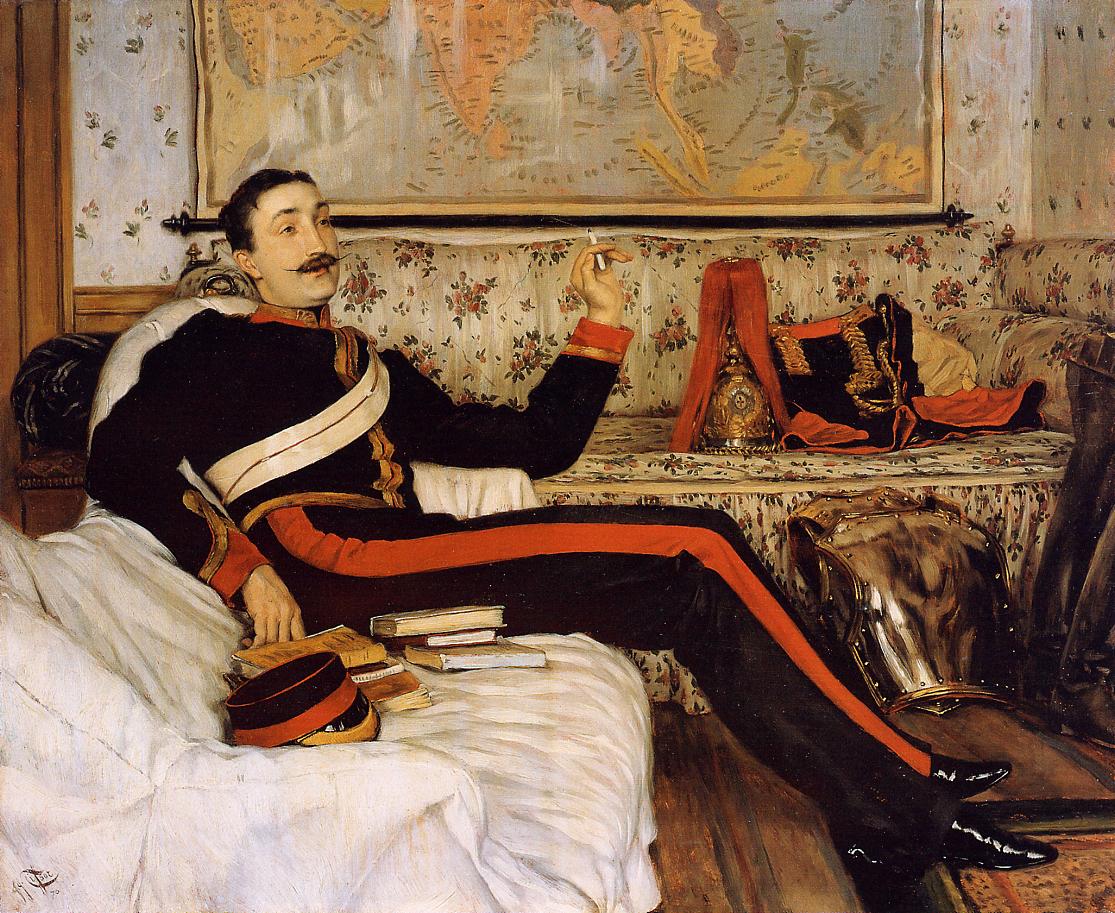
James_Tissot_-_Captain_Frederick_Gustavus_Burnaby

Jacob Rees-Mogg’s languid pose on the Treasury bench launched a thousand memes on social media. Five observers interpret his body language for us.

Philip Mould, art dealer: What’s so interesting about that Rees-Mogg pose is that, unlike 99 percent of the canon of British portraiture, he’s reclining. The political office of the 16th, 17th and first half of the 18th centuries was indistinctive from the aristocratic one. Even Cromwell would stand like a Van Dyck when he was being painted. The idiom of portraying political power was always to make you look like an aristocrat. Then, in the later 18th and 19th centuries, politicians were increasingly portrayed with a new democratic quality: you think of Thomas Lawrence and Millais doing Disraeli and Gladstone – they’re intransigent, statutory. There’s a new sobriet, with darker clothes that make it hard for artists to deal with. Artists then had to emphasise gesture and facial expression in a way that they hadn’t in the ostentatious iconography of yesteryear. And although it breached protocol, if you’re a portrait painter who wants to express the role of Leader of the House, what better way to style him than as reclining over a number of benches? Rees-Mogg is a sophisticated chap who knows his art and history; what I find so amusing is that a portrait painter would likely have depicted him in a similar way. Prime ministers are more problematic to depict. When it came to someone like Thatcher, that was a real task because there had never been a language for female power in the artistic tradition. So artists were confused; Antony Dufort famously decided to include her handbag in his statue, which in the classical statuary tradition has no heritage. What unites all prime-ministerial representations is a certain amount of smouldering dominance: Tony Blair by Jonathan Yeo epitomises that. There’s a Shakespearean look of introspection about him, which reminds me of that Enoch Powell quote, “All political careers end in failure.” Boris Johnson is quite interesting because you’d slightly want to fill the canvas with his head; he’s the political equivalent of Seumas Heaney. That’d be the only appropriate way of portraying him. Ultimately, whether serendipitously or not, Rees-Mogg expressed himself in a way that highly successfully resembles the Leader of the House in the artistic form. It’s fractionally subversive; only he can get away with it. The whole process of portraying fugitive political power is one I’ve made a study of. Increasingly, the artist is somewhat limited in their ability to express office and hierarchy, as style has changed and modernised. But gesticulation like Rees-Mogg’s really achieves that. Griselda Pollock, art historian: I am sure there are many people to write about his adoption of the pose of Goethe reclining by Tischbein, although I would not want to address it myself. I think men like that think they own the world – and everything in their background makes them feel at home in it. At least Goethe looks pensive and aware of history… Toby Young, journalist [replying to Pollock]: I don’t believe cishet white males feel “entitled” to behave in particular ways. On the contrary, their membership of those now reviled categories is more likely to inhibit them. Rees-Mogg was signalling his contempt for the Remainers trying to block Brexit, many of whom are themselves cis-het white males, so trying to frame it in those identitarian terms doesn’t make much sense. Rees-Mogg shouldn’t have apologised for it. Signalling your contempt for the House of Commons or House of Lords by slouching is a fine and ancient tradition in the Palace of Westminster. Twitter has had a net negative effect on politics. MPs pay it far too much attention because they mistakenly think of it as a kind of focus group that’s representative of Britain. In fact, Twitter users are more urban, young and left-wing than the rest of the country. Plaid Cymru spokesperson: That now infamous image says it all, really. It has become a symbol of certain politicians who have pursued a probably disastrous Brexit with little thought for its implications on the lives of people across these nations. Any version of Brexit would be bad for Wales, but the truth is that Messrs Johnson, Rees-Mogg et al know little and care less for our nation. But in a wider sense, that image is also a symbol of what the entire Westminster establishment had come to represent. It was broken. It was paralysed. Mark Stephens, lawyer: Parliament has allowed photography and cinematography for a long time, so this is nothing new. Nowadays, part of the cut and thrust of politics is greater public scrutiny and part of that is to have images shared from the chamber, whatever is going on. It’s become an important part of our democracy to be able to see what MPs do when they’re in Parliament, whether that’s playing Candy Crush on their phone, making a speech or reclining across the benches....

Subscribe to The Mace

Join the member community shaping British politics and stay ahead of what's really happening in the world of politics and public affairs, with expert analysis, breaking news, and insider insights from Westminster and Brussels. The Mace is the leading news source and resource for the government affairs industry, offering required reading and lobby intelligence for professionals.

To see what you are missing out on by not subscribing to The Mace, click here to download our full membership info-pack. This includes having no paywall on op-ed content or profiles/interviews, allowing professional profiles to be read with maximum impact and visibility by government, special advisers, MPs, peers, civil servants, and policy and political decision-makers.

‘Al is a born leader’: The dark horse of the Labour leadership contest 

Lucy Carrier-Pilkington | June 16, 2026

Ex-Royal Marines commando emerges as the plan B candidate in the race for Labour leadership.

The social media ban: game changer or rushed job?

Lucy Carrier-Pilkington | June 16, 2026

Debate has erupted over whether the new policy is an overdue attempt to rein in Silicon Valley or a short-sighted, politically motivated move that will push children towards

Reform v Restore: the English civil war in Makerfield that will decide the next Labour prime minister

William Cash | June 15, 2026

With Restore and Reform tearing votes off each other, the Makerfield by-election could propel Andy Burnham into Number 10. But, asks William Cash, will Restore's percentage of the

Memo to the new Defence Secretary before the NATO summit: “It’s not all about the money”

Mace | June 12, 2026

Creating a Defence Industrial base with no new money is going to be a challenge for any Defence Secretary. But, argues defence expert William Wallace, there are several

Reflections on May: London’s new political landscape

Jonny Popper | June 11, 2026

May’s local elections completely transformed London’s political landscape, argues CEO Jonny Popper.

When it comes to English police reform, do not repeat the mistakes made north of the border

Mace | June 5, 2026

The dismal results of reducing the police force in Scotland should act as a cautionary deterrent for English police reform, writes Sharon Dowey, a former member of the

Checkmate DC’s bold London move

William Cash | June 5, 2026

Tristan Breijer is the new London head of Checkmate Government Relations. The move into London gives the US lobby firm its first European base, bringing its global power-broking

Gradually and suddenly: how VAT is slowly killing off traditional private education

Mace | June 5, 2026

Latest Dept of Education figures reveal over 40,000 independent school pupils dropping out since Labour's VAT raid. But, The Mace argues, surging fees, an arms race for facilities

What the Mandelson files reveal about Global Counsel

Lucy Carrier-Pilkington | June 4, 2026

Lord Peter Mandelson has found himself in the headlines again, as the 'Mandelson Files' reveal the true extent of his involvement in the Labour Party.

Do outsiders in government really work?

Mace | June 4, 2026

As politicians call for more external appointments in Whitehall, Professor Nada Kakabadse argues that the real challenge lies not in recruitment, but governance.