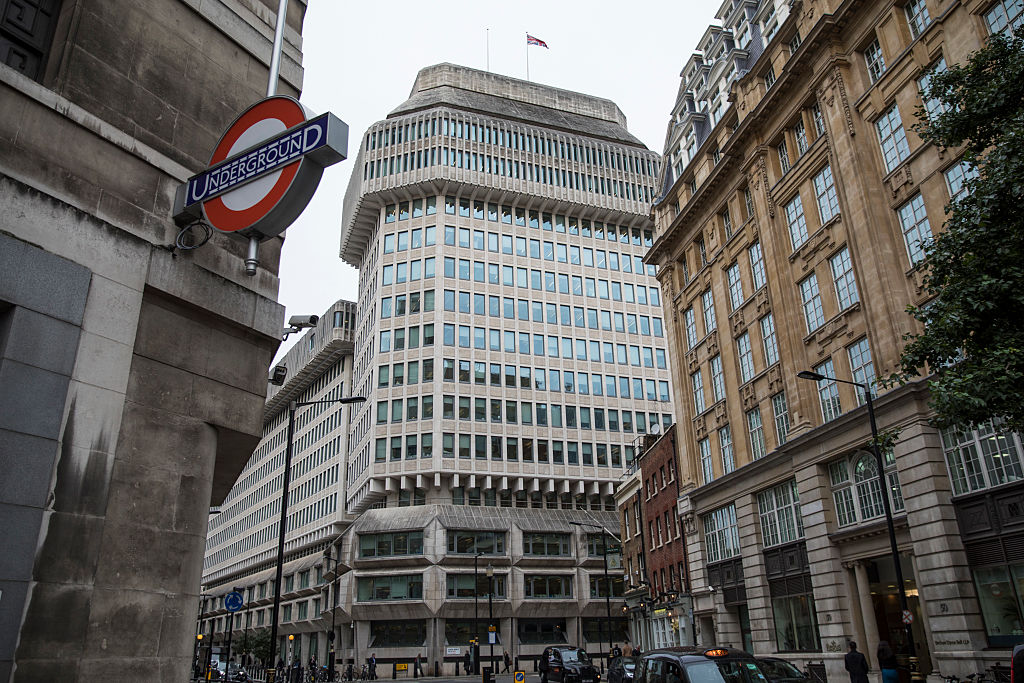
LONDON, ENGLAND - NOVEMBER 17: A general view of the Ministry of Justice on November 17, 2016 in London, England. Brutalism is a style of architecture, which was popular between the 1950s and 1970s, and is typically characterised by large forms and exposed concrete or brickwork. In a speech this month British Transport Minister John Hayes described such modernist architecture as "aesthetically worthless" and called for a "revolt against the Cult of Ugliness". (Photo by Jack Taylor/Getty Images)
Putin’s invasion of Ukraine proves that the West has been asleep at the switch while he set out his plans in plain sight. How did our systems fail us?
As our continent is beset by major state-on-state conflict, there should be reflection on what has gone wrong with Nato and Western policy. Nobody should divert blame from the dictator Putin, whose grotesque narrative about saving Russians in Ukraine from a genocide at the hand of ‘Nazis’ echoes Hitler’s justification for the annexation of the Sudetanland in 1938. Yet it’s true that there has also been a “systems failure” in Whitehall and other key Nato governments.
Leon Trotsky is attributed with the observation: “You may not be interested in war, but war is interested in you.” While Putin has been taking advantage of optimism and complacency, the free world has been too little “interested in war”, and how to deter it, and now war is interested in us.
Complacency has strengthened the confidence of dictators and illiberal regimes in the effectiveness of their autocratic systems. Autocrats never face the electoral cycle, so they can think long-term more easily than elected governments. They can impose order, suppress dissent, generate their own narrative and history. They can put their own interests ahead of their national interests. Autocracy still has to be based on a bargain of sorts: in return for your lack of freedom, you will be looked after (a bargain which the sanctions on Russia will, over time, cause to unravel). By contrast, democracies look chaotic, particularly recently. Chinese President Xi’s speeches openly boast of the superiority of the Chinese system over the West’s. What have we done to prove him wrong, in the past two years? Not much!
The UK’s constitution is not codified into a single document, but depends upon a variety of statutes and understandings about who does what, about how they are made responsible and held accountable. The central pillars of our constitution are institutions: Parliament, the government and the judiciary. Other institutions have, however, become vital bulwarks of stability and power. Since the middle of the 19th century, it has included the civil and diplomatic services.
The free world has clearly been asleep at the switch with regard to Putin, ever since he set out his plans to the Munich Security Conference in 2007 and then invaded parts of Georgia in 2008. We have had a National Security Council since 2010: why does it not do what it says on the tin? What is the point of a permanent impartial civil service, if they are not there to give the right advice to ministers, at the right time, whether they want that advice or not? They are there “to serve the government of the day”, but not to abdicate their responsibility for knowing what they should know, and for telling truth to power. Only pockets of the system work well (such as around anti-terrorist operations).
The relationship between ministers and officials is not what it used to be. A lot of the institutional trust, which embodied those hidden understandings, has broken down. The “Spadocracy” has complicated things, and there is a type of minister who just wants civil servants to take orders, and expects them to carry them out. It should be obvious to them that civil servants have neither the capability, knowledge or expertise to do what is asked of them, nor the authority within the system, which involves other departments, such as the Treasury. Overbearing leadership from Number 10 absolves officials of responsibility for giving impartial advice.
Nevertheless, we depend upon civil servants, diplomats, the security services, the leadership of the armed forces, in the two most relevant departments (the MoD and the FCDO) to be vigilant for new threats. These parts of the system are unambiguously “interested in war” (or should be). The MoD has proved its worth in this crisis, both for arming and training the Ukrainians in the years before this crisis, and for gathering and using its intelligence to warn of the attack, when many were still disbelieving.
We have however suffered a “systems failure” for over a decade or more. The Putin threat was not obvious enough to galvanise Nato governments in advance. What warnings there may have been were too easily brushed aside in favour of more popular social goods such as “the big society”, “levelling up”, the NHS and the pensions triple lock. So what can we learn from this, which needs to be embedded into our constitutional settlement for our future peace and security? It must be widely understood, practised by successive governments of whatever political hue, and it must demonstrate its own success in order to be sustainable. Who in government is thinking of how to achieve this?...
Subscribe to The Mace
Join the member community shaping British politics and stay ahead of
what's really happening in the world of politics and public affairs,
with expert analysis, breaking news, and insider insights from
Westminster and Brussels. The Mace is the leading news source and
resource for the government affairs industry, offering required
reading and lobby intelligence for professionals.
To see what you are missing out on by not subscribing to The Mace, click here to download our full membership info-pack. This includes
having no paywall on op-ed content or profiles/interviews, allowing
professional profiles to be read with maximum impact and visibility by
government, special advisers, MPs, peers, civil servants, and policy
and political decision-makers.
The news that former Home Secretary Sir Grant Shapps has failed to make the new Tory candidate list has put fear into dozens of former Conservative MPs. Whether
In her bestselling book, Sarah Vine reinvented the political wife memoir. Soon out in paperback, Melanie McDonagh sat down with the ex-wife of Michael Gove to discuss the
After running Sky, Andrew Griffiths become a high flying MP who rose through the Johnson and Sunak governments. In his Mace profile, the Shadow Secretary for Business and
With invitations coming in to speak at the 2026 autumn party conference season, freedom of speech campaigner Toby Young reflects on his political status 'upgrade' from hack to