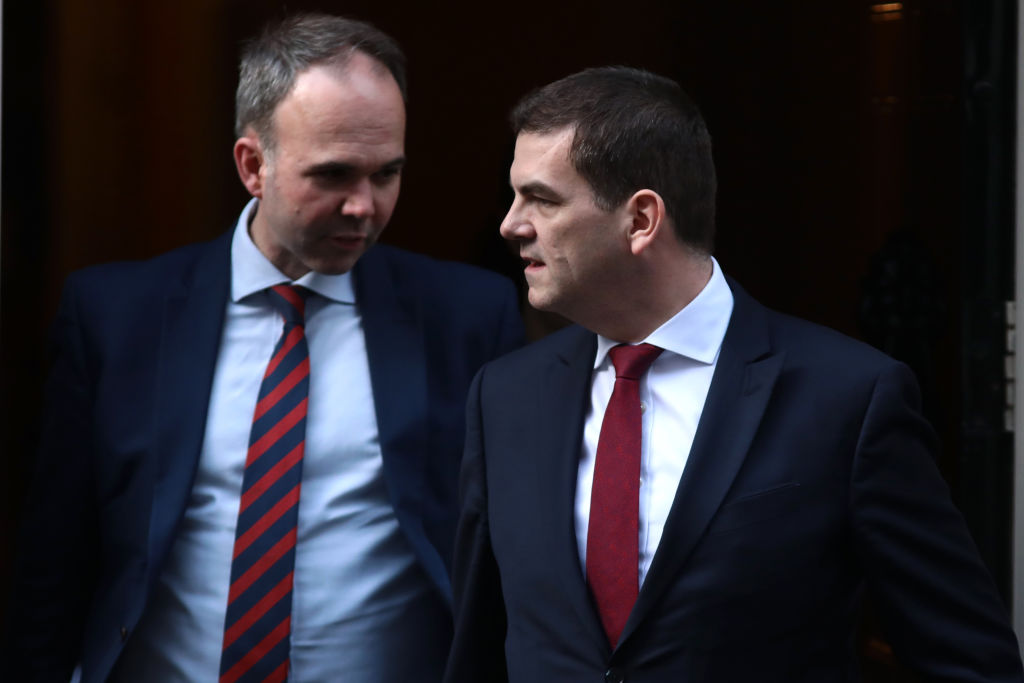
Sir Olly Robbins talking with former No 10 Chief of Staff Gavin Barwell -Getty Images
As the blame game between Keir Starmer and Olly Robbins unfolds, Lucy Carrier-Pilkington argues this is just the latest in a pattern of governments pinning responsibility on civil servants.
Former head of the Foreign Office, Sir Philip Barton, told MPs today that the Cabinet Office suggested Peter Mandelson should be waved through security checks for his prestigious role as US ambassador.
Sir Philip, who revealed that he was not consulted about Mandelson's appointment, also said that the Cabinet Office argued Mandelson was a 'fit and proper person' who did not require Developed Vetting.
Furthermore, Prime Minister Keir Starmer faces accusations from sacked senior civil servant Sir Olly Robbins of having a “dangerous misunderstanding” of the official vetting process. Robbins, who was given the boot by Starmer for “failing” to tell him that Peter Mandelson had not passed the vetting process during his appointment as US ambassador, has challenged the narrative placing blame on his shoulders.
The former civil servant said: “I hope it’s clear from everything I’ve said so far that this is a dangerous misunderstanding of the necessity of confidentiality in the process. “You are not supposed to share the findings and reports of UKSV [United Kingdom Security Vetting] other than in the exceptional circumstances where doing so allows for the specific mitigation of risk.”
Robbins further added that his office had been under "constant pressure" from Number 10 to speed up the process of Mandelson’s appointment.
He claimed that: “[There was] never any interest, as far as I recall, in whether, but only an interest in when [Mandelson could take office].” Damningly, Sir Keir’s former chief of staff, Morgan McSweeney, reportedly ordered the Foreign Office to “just f---ing approve” the appointment.
Kemi Badenoch has chipped in, arguing that Sir Olly’s evidence is “devastating” for Starmer and that the PM had “misled the House”. However, despite allegedly intense pressures on the Foreign Office as well as potential ignorance from Number 10 about the UKSV process, civil servant Olly Robbins was the one hung out to dry.
"Civil servant Olly Robbins was the one hung out to dry."
But this is just another episode in a series of incidents where civil servants are forced to take the brunt, often in the form of a sacking, for the repeated mistakes, scandals, and lapses of judgement from the government.
In recent history, there was the case of Jonathan Slater, former Permanent Secretary for the Department for Education, who was sacked over the controversial algorithm briefly used to award A-Level results in 2020. Despite the forewarning about issues with the algorithm, the Prime Minister at the time Boris Johnson claimed the algorithm to be “robust” and “dependable".
When the disastrous A-Level algorithm was cancelled, a government spokesperson said: "The Prime Minister has concluded that there is a need for fresh official leadership at the Department for Education.” Yet, Deputy General Secretary of Prospect, Garry Graham, responded to the sacking saying: “It used to be ‘advisors advise, ministers decide’.. now it seems we need to add 'and civil servants take the blame’.”
“It used to be ‘advisors advise, ministers decide’.. now it seems we need to add 'and civil servants take the blame’.”
In addition, FDA General Secretary Dave Penman said: “If it wasn’t clear before, then it certainly is now – this administration will throw civil service leaders under the bus without a moment’s hesitation to shield ministers from any kind of accountability."
Another instance of ministers making unfair allegations came in the case of former Home Office top civil servant Sir Philip Rutnam, who resigned after becoming the “target of a vicious and orchestrated campaign against him,” which he accused Priti Patel of masterminding.
Rutnam claimed that Patel had made various untrue claims against him including that of briefing the media against her. The ex-civil servant, who was originally suing the government for constructive dismissal, stated that: “I have received allegations that her conduct has included shouting and swearing, belittling people, making unreasonable and repeated demands – behaviour that created fear and that needed some bravery to call out.”
Starmer, at the time, argued that Rutnam’s resignation was the latest in a wealth of evidence indicating a “serious breakdown of government”. One wonders if the same argument will cross his mind this week.
Furthermore, former Permanent Secretary of the Treasury, Tom Scholar, was sacked before the introduction of Kwasi Kwarteng's disastrous mini budget that served to entirely destabilise the UK economy and end the reign of Liz Truss.
Tom Scholar, who was Permament Secretary to the Treasury when Liz Truss came to power, was sacked in an effort to root out 'Treasury orthodoxy.' (Photo by Peter Macdiarmid/Getty Images)
Penman commented that Scholar’s ...
Subscribe to The Mace
Join the member community shaping British politics and stay ahead of
what's really happening in the world of politics and public affairs,
with expert analysis, breaking news, and insider insights from
Westminster and Brussels. The Mace is the leading news source and
resource for the government affairs industry, offering required
reading and lobby intelligence for professionals.
To see what you are missing out on by not subscribing to The Mace, click here to download our full membership info-pack. This includes
having no paywall on op-ed content or profiles/interviews, allowing
professional profiles to be read with maximum impact and visibility by
government, special advisers, MPs, peers, civil servants, and policy
and political decision-makers.
For 10 months, ex-army officer James Jeffrey trekked 3500 km across Europe by foot. The scale of migration he witnessed may not have been as dramatic as the
After heading the Makerfield by-election comms team, Grace Pritchard was singled out by Andy Burnham as being a key part of his northern campaign team. The self-styled 'Yorkshire
The Civil Service is ready to support Dame Antonia Romeo's flagship changes to government machinery - notably relating to AI and devolution - under new prime minister Andy
Andy Burnham is shaking up government with more changes than by any incoming prime minister in memory. But, asks Sir Bernard Jenkin MP, does he understand why the
UK aviation can decarbonise while meeting growth ambitions, but urgent government action is needed to prevent costs increasing for passengers and the sector losing its competitive edge.
The news that former Home Secretary Sir Grant Shapps has failed to make the new Tory candidate list has put fear into dozens of former Conservative MPs. Whether
Cameron Brown, a former special advisor to the Chancellor of the Exchequer, explains why Burnham's VAT cut on energy bills is a measure people will actually notice.