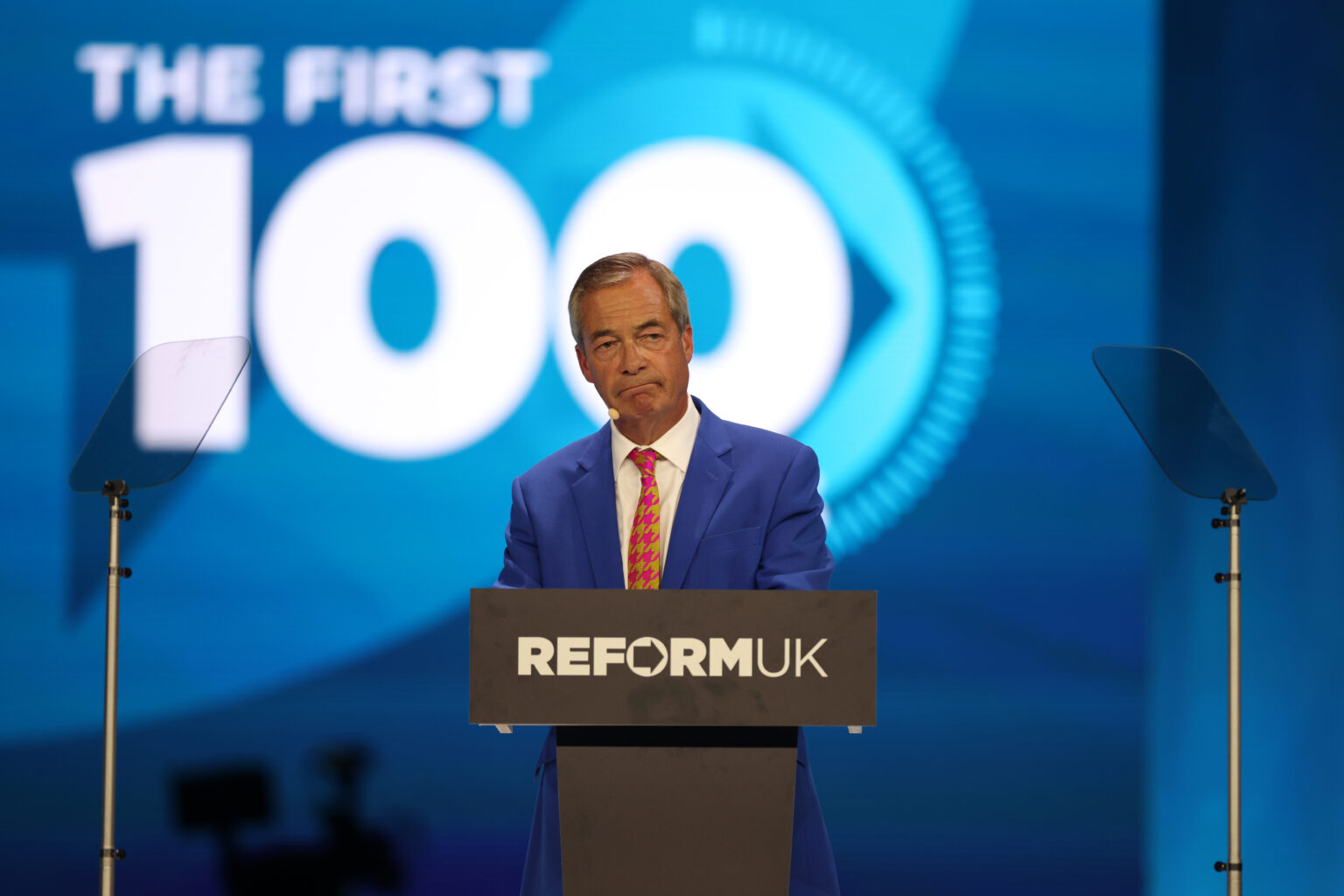
Seasoned Farage aide-de-camp Gawain Towler reflects on Reform's first ever Business Day at the NEC - and what it's like when a media grenade goes off during the Gala Dinner at 7pm.
I’m at the NEC in Birmingham for the first ever Reform UK “Business Day”. Here to smile, make polite noises and sing for my supper. First job, reach the front of the long queue. There are over 1,000 “business” delegates, over double from last year, including the likes of Lloyds Bank, NatWest (yes), Vodafone, JCB, and many defence firms.
“Sorry, sir, you don’t exist,” I am told.
After a momentary existential crisis, a fellow Reform UK board member suggests the ancient remedy – the “Don’t you know who I am?” gambit. No point. They wouldn’t, and that way lies only humiliation. Better to stand in line like a lemon than to be publicly made into one.
Rescue came in the form of a passing senior member of Reform’s staff, recently promoted to the public affairs team, friendly and visibly harassed, bald patch visibly widening as the seconds ticked by. He sorted the whole business inside a minute. It wouldn’t be a proper party conference without ticketing or accreditation problems, and I would have felt short-changed by their absence. Somewhere in the liturgy of party conferences it’s written that a man shall be turned away from a door he helped to hang.
The queue was the real story anyway. Hundreds of people standing about in the morning, all of whom had paid good money to give up a working day to a party with no ministers and no power to sign anything into law. Nobody queues like that for a party that is going nowhere.
Panel beating
The Business Day roundtables – seating options included the Heathrow Lounge, the ITV Lounge, and the Spectator drawing room-style pop up decorated with covers – were packed to the walls, and the questions came at whatever the opposite of thick is, and fast. Almost none of them came from the platform.
They came from delegates. From some of the couple of hundred senior councillors who now run actual places with actual budgets and are discovering what that means. From the thousand and more business representatives who had bought a ticket and fully intended to extract the value of it. And from the media.
The mood was cheerful and entirely unsentimental. Nobody had come for a speech though there were some. They wanted to know what we would do, in what order, and who was going to pay for it, which is a much harder conversation than the one a party had with its own faithful the next day in the main hall.
A panel can survive a friendly audience. It struggles rather more with a paying one. That, I suspect, was the point of the exercise. It was the reason the day felt less like a party occasion than like a very large and very public job interview conducted by people who had already read the party CV.
Testing times
The media – including the Sun and all the tabloids; the Daily Express had their own stand – were amazed to be let in at all, and more amazed still to be engaged with once inside.
Go to the business days of the other parties, if they will have you, and the form is well established. Press are welcome to admire the room, photograph the lanyards and note the sponsors. Then, the moment the business itself gets going, they are ushered out with a degree of ostentation that rather gives the game away. Whatever is said in that room is said on the understanding that it will not be said anywhere else.
Not at Reform. The press stayed in, sat through, listened and asked. They are part of the learning curve rather than an interruption to it. For a party still building its policy architecture in public, that is not generosity, it is self-interest. If you are going to be tested, better to be tested in the room with the notebooks in it than in a column three weeks later by someone who was shown the door before the interesting bit. Confidence and openness turn out to be the same thing but wearing different clothes.
‘Local difficulty’
Doing an interview with Gary Gibbon of Channel 4, a passing cove sauntered up wondering aloud what Michael Crick was doing in the building. Gary had to point out that he was not, in fact, Mr Crick. I am still not certain which of the two of them would be the more appalled.
Which brings me to the line that gets written every year, that the press are not welcome among us. Set this against the early drama of the conference when a climate activist group and Channel 4 had between them run a sting operation on the party. There have been some casualties as we all know.
It had actually been on Tuesday, three days before the conference opened on 3 September, that I first got wind that Channel 4 were doing a hit job on the party – with the grenade going off at 7pm as some hundreds of VIP delegates were sitting down to the Gala Dinner – and so the first day of conference was a little bit waiting for what an earth was to come. They had had an undercover reporter. The story came, the story went, two people responsible stood down and we have an investigation.
I’m very sorry that it happened but we’ve done the right thing in the circumstance. Fact is, this sort of thing will continue to happen and we have to improve our structures and our due diligence. What was amazing in the morning was the mood of the conference. The members, the supporters. It was a local difficulty. We shall see what that means in the long run.
Despite the Channel 4 hit, the media at the NEC are treated, pretty much universally, with courtesy. Prospective interviewees stopped and talked. The general public, who have rather more reason than most to feel got at, were polite to a fault. Not one incident that I saw or have heard about.
That is either remarkable forbearance or the ordinary manners of ordinary people, and I know which explanation I prefer. Either way, the story that we cannot bear scrutiny died quietly in a conference centre this week, unmourned and largely unreported.
Gawain Towler is a Reform UK board member and worked for Nigel Farage as his press officer for many years. He is also a senior adviser at Bradshaw Advisory.