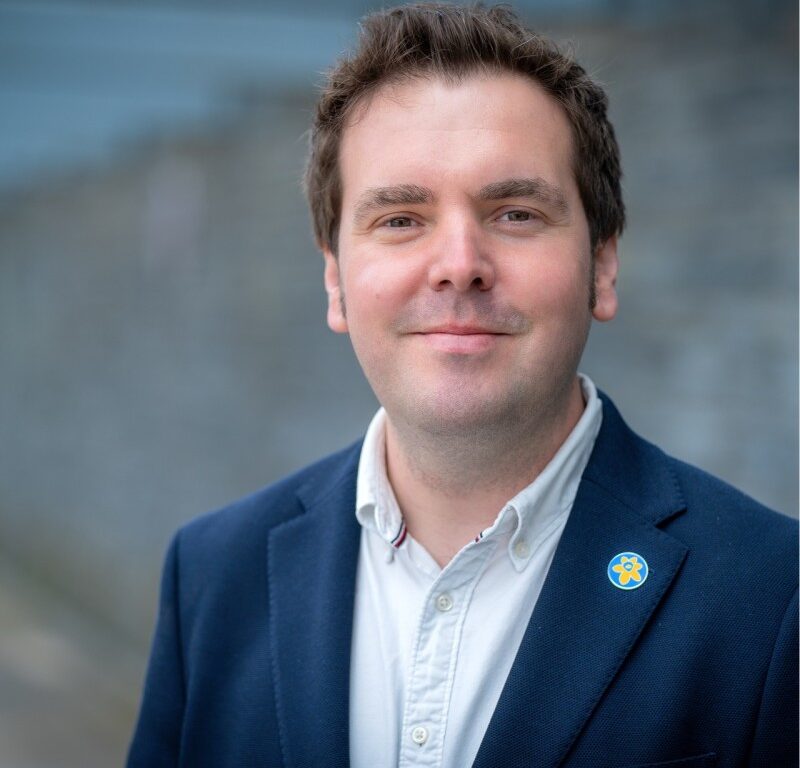
Leader in UK Public Affairs: Jon Antoniazzi, Associate Director for Policy & Public Affairs, Marie Curie
Mace | 29th April 2026 | In-House Public Affairs, Politics, Westminster Index
After his father died of a NHS failure and his mother from a late cancer diagnosis, Jon Antoniazzi has been on a determined career path to change health policy
“I saw the other candidates and thought… ‘I could do a better job", says Jon Antoniazzi, whose entry into public affairs began behind a student union bar — and with a decision to run for president of the student union. It was a decision which set the tone for a career in advocacy, policy and public affairs.
“I started out as a ‘bag carrier’,” he says, moving through agency work before what he describes as his “big break into health policy” — setting up the policy unit for a cancer charity in Wales.
For Antoniazzi, that connection is deeply personal. “My Dad died because of a failure in the NHS in Wales and my Mum was diagnosed late with cancer,” he says. It is a stark account, but one that explains his motivation. “I work right at the intersection of trying to make improvements that will improve health and care… at least that’s what I keep telling myself.”
That lived experience shapes his view of the biggest challenges facing the system. “Unpaid caregivers need to be properly supported and not taken for granted,” he says, reflecting on his own time as a carer. As health systems shift towards community-based care, he argues, carers are “the last line of defence between the community and A&E corridor” — a role that remains under-recognised and under-resourced.
His work at Marie Curie reflects that system-wide perspective. Rather than focusing on isolated policy changes, he points to the need to connect different parts of the health and care system. A recent example is the charity’s Senedd campaign, At Breaking Point, led by colleagues Natasha Davies and Dr Tomos Evans. “This was a major first step in linking end of life care as a whole system issue,” he says, highlighting its impact across emergency departments, community provision and social care. “I’m extremely proud of them.”
Earlier in his career, he played a role in shaping the 2016 Programme for Government agreement between Plaid Cymru and Welsh Labour. “Almost overnight improving access to new and high cost medicines in Wales,” he says — while also embedding patient voices more directly into policy thinking. It is a reminder that even within constrained systems, well-targeted advocacy can deliver tangible change.
His approach to public affairs is grounded in pragmatism and perspective. “Some people are radiators and some people are drains,” he says, recalling advice that has stayed with him. “You’d rather stand next to a radiator.” It is a simple way of describing something more fundamental: the importance of energy, attitude and collaboration in environments that can otherwise be demanding and complex.
He is also reflective about career development. “Step back and map out your life chapters,” he says. “While you might be having a bad time right now, you are on a positive trajectory.” It is advice that feels shaped by experience — both personal and professional.
His leadership philosophy follows a similar line. “Hire smarter than you and especially in your leadership blindspots,” he says, alongside creating “an environment that allows for ideas to flow and compassionate challenge to be the norm.” It is an approach that prioritises openness and continuous improvement over hierarchy.
On artificial intelligence, he takes a balanced view. “AI creates a real competitive threat to traditional intelligence gathering,” he says, while also recognising its benefits in expanding policy analysis and handling complex evidence. As with others in the field, the implication is that AI will change how public affairs is done — but not the need for judgement.
Outside work, life is grounded in the community. “Mountain biking in the Welsh countryside… walking my three lovely dogs… volunteer seagoing crew for the RNLI,” he says — a mix of activity and service that mirrors his professional focus on care and resilience.
His influences reflect both personal and political experience. He cites Alastair Campbell’s writing on mental wellbeing as important, particularly in the context of his own experience with depression. At the same time, his view of politics is shaped by family. “My Dad… said I’m too nice for politics,” he recalls, contrasting that with his sister, Labour MP Tonia Antoniazzi, who “handles it with class.”
His own experience of media exposure was less comfortable. “Arguing with Sir Vince Cable about tuition fees live on the lunchtime news,” he says — adding, “hopefully my last.”
Quick-fire Q&A
How did you start in public affairs?“I worked on a bar in the Students’ Union… I saw the other candidates and thought ‘I could do a better job’… started as a ‘bag carrier’.”
What policy issue keeps you up at night?“Unpaid caregivers need to be properly supported… they’re the last line of defence between the community and A&E corridor.”
What’s the appeal of in-house advocacy?“I work right at the intersection of trying to make improvements that will improve health and care.”
Proudest achievement?“Influencing the 2016 Programme for Government… improving access to ...
Subscribe to The Mace
Join the member community shaping British politics and stay ahead of
what's really happening in the world of politics and public affairs,
with expert analysis, breaking news, and insider insights from
Westminster and Brussels. The Mace is the leading news source and
resource for the government affairs industry, offering required
reading and lobby intelligence for professionals.
To see what you are missing out on by not subscribing to The Mace, click here to download our full membership info-pack. This includes
having no paywall on op-ed content or profiles/interviews, allowing
professional profiles to be read with maximum impact and visibility by
government, special advisers, MPs, peers, civil servants, and policy
and political decision-makers.