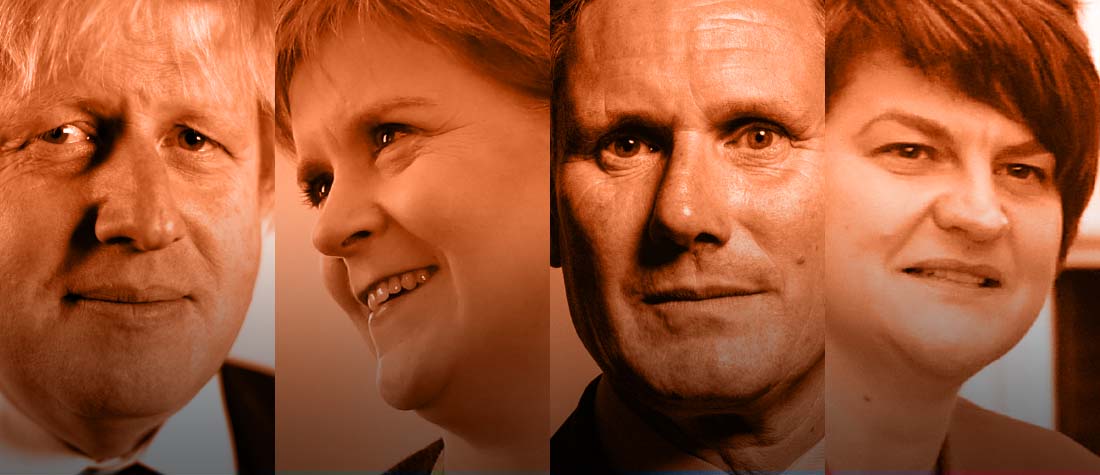
The movers, shakers and rule-breakers making their mark in Westminster
When our panel convened during the latter stages of lockdown, we thought we had come up with a definitive list of the most powerful and influential people in British politics. However, as we all know, if a week is a long time in politics, two months in an age. So out went Gavin Williamson and Sir Mark Sedwill. In came Sir Ed Davey and Douglas Ross.
Power struggle
Any list like this is open to criticism for who is left out and who forms the top ten. “I can’t believe [insert favourite politician’s name] is only at number 69” will be a common cry, but that’s the joy. There is no science to it, and it’s all about opinion and judgement. Our seven-strong panel was a mixture of journalists, ex-politicians and keen observers of the political scene. We spent a long time debating the difference between power and influence and whether Dominic Cummings was the most powerful man in Britain, or was his power limited by the prime minister? You will see from the top two placings that we came to the conclusion that despite some evidence to the contrary, Boris Johnson was still his own man and there were plenty of examples of him reining in some of his svengali’s more, ahem, interesting reform ideas.
There are naturally more Conservatives on this list than Labour representatives (32-28), given they are the party in power. Interestingly, when you try to divide the list up into left and right, the balance shifts 38-44 in favour of the left. In terms of gender balance, there are only 32 women on the list, although we would expect that proportion to grow in the coming years. There are 14 BAME representatives in the list, in line with the population, but interestingly there are three in the top ten.
We had an interesting discussion about where to place Sir Keir Starmer. In the end we plumped for just above the Speaker of the House of Commons but just below the first minister of Northern Ireland. Yes, he has made his mark on his party, and indeed the country, but the only place he exerts power is over the Labour Party. The second knight of the realm to lead a political party, Sir Ed Davey is the sole Lib Dem representative on the list, while the SNP fills five places, including, perhaps surprisingly, Alex Salmond. We feel Mr Salmond’s influence on his country’s politics is a long way from being over.
We indulged ourselves in a bit of talent spotting too, choosing a selection of individuals who we feel will shoot up the list next year, including Rosena Allin-Khan and Ben Nunn.
Cummings and goings
There are also a multitude of names that the political geeks are familiar with but the public is not. Munira Mirza, at number eight is the low-profile head of Boris Johnson’s policy unit. If Dominic Cummings performs the task of the PM’s right hand, Mirza is the left hand equivalent. Further down the list we find Helen MacNamara, a senior civil servant in charge of ethics. Her predecessor, Sue Gray, was often referred to in government circles as the most powerful person in government.
We also decided to include the Archbishop of Canterbury and the Prince of Wales as serial influencers. When they utter any word in public they are listened to and reported and their recommendations are sometimes acted upon. That’s real influence, whether we like to think of them as active participants or not.
Cabinet makers
It is possible to make a case for each and every cabinet minister being on this list, given the power they potentially wield, but some are more obvious than others. Oliver Dowden, the culture secretary, doesn’t make the cut, but only because his department is one where, as secretary of state, you can make lofty speeches but can you exercise real power? Sometimes, maybe, but not as often as the health secretary, Matt Hancock, whose profile has risen exponentially this year, for obvious reasons. Many cabinet ministers have been largely anonymous this year or have made zero impact. Brandon Lewis makes the cut because he’s one of the more regular government voices in the media – wheeled out when the going gets tough – whereas his equivalents in Wales and Scotland don’t make the cut because they have little UK national profile or influence.
It will be interesting to see when we come to compile the 2021 list how many of the current list cling on. A year, after all, is an eternity in politics.
Iain Dale's Top 100 in British Politics
[top100p]...
Subscribe to The Mace
Join the member community shaping British politics and stay ahead of
what's really happening in the world of politics and public affairs,
with expert analysis, breaking news, and insider insights from
Westminster and Brussels. The Mace is the leading news source and
resource for the government affairs industry, offering required
reading and lobby intelligence for professionals.
To see what you are missing out on by not subscribing to The Mace, click here to download our full membership info-pack. This includes
having no paywall on op-ed content or profiles/interviews, allowing
professional profiles to be read with maximum impact and visibility by
government, special advisers, MPs, peers, civil servants, and policy
and political decision-makers.
From IT engineer to Foreign Office diplomat to advertising regulator, Konrad Shek has built a career by going where curiosity leads - and his instinct for translating complexity
In her bestselling book, Sarah Vine reinvented the political wife memoir. Soon out in paperback, Melanie McDonagh sat down with the ex-wife of Michael Gove to discuss the
As CEO of Inline Policy, Shomik Panda combines political insight with commercial understanding. Selected as a Mace Top 100 lobbyist, expertise includes where digital technology intersects with travel,
After running Sky, Andrew Griffiths become a high flying MP who rose through the Johnson and Sunak governments. In his Mace profile, the Shadow Secretary for Business and
As Chief Executive of CIPR, Alastair McCapra is both a public affairs industry leader and also one of its more persistent critics. In his Mace profile, subjects range