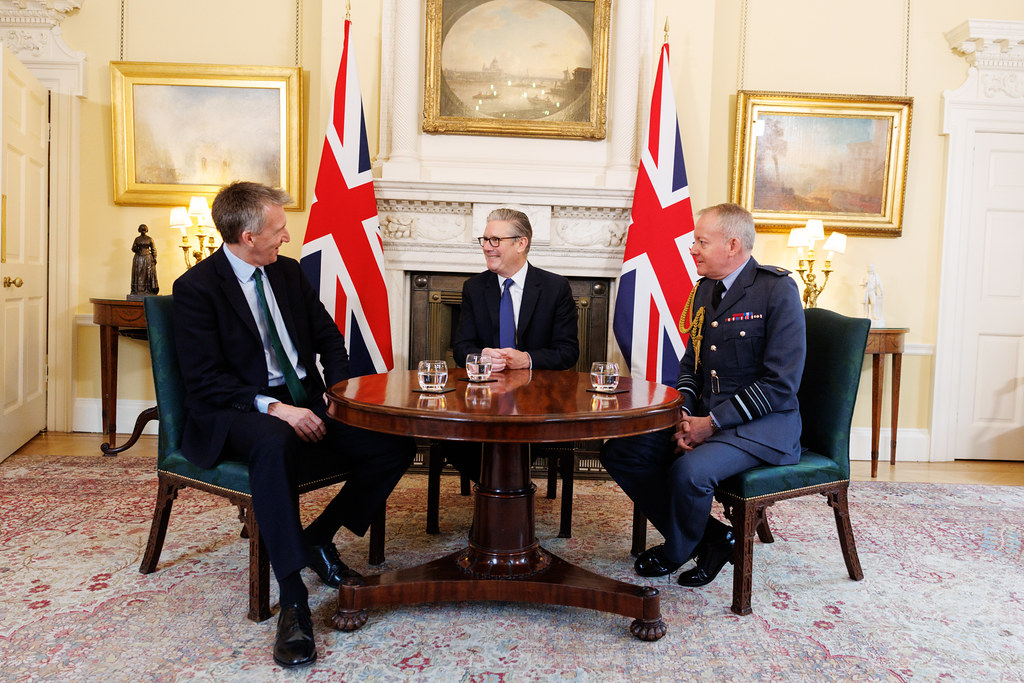
Labour won a landslide victory in 2024 (Photo by Dan Kitwood/Getty Images)
Whilst it may seem easy to cast generalisations over Labour MPs, the reality is that most networks date back decades, writes Mark Leftly
A solid local election launch will always include some big political names, particularly if they are from the same region or neighbouring areas.
It might, therefore, seem unsurprising that Labour deputy leader and Manchester Central MP Lucy Powell stood beside local parliamentarian James Frith at the formal start of the party’s council campaign efforts in Bury this April. Indeed, the political colossus of Greater Manchester, Mayor Andy Burnham, was also at the event, telling activists: “We need to back Labour in Bury, because Bury helped us build the success story that is Greater Manchester.”
Yet Powell was central to the wider party’s overall local election strategy, having spoken alongside Sir Keir Starmer at the main campaign launch in Wolverhampton only a few days earlier. She was immediately sent to Waltham Forest in London, helping local councillors stave off the growing threat of the Greens in the capital.
Powell’s time was precious. Appearing in Bury, even at a time when support for Reform is mounting, hints at something deeper about Labour and its informal structures - the hidden networks that are vital to understanding such a tribal party.
Frith and Powell go back a long way. They sat on the Education Select Committee during the 2017-19 Parliament, before Frith lost and regained his Bury North seat. As young parents, they also worked together on the All-Party Parliamentary Group on Nursery Schools, Nursery and Reception Classes, which sought additional funding packages.
All parties have informal connections, including friendships and rivalries that date back decades to student politics or even just as university colleagues. The competitive tension between Boris Johnson and David Cameron infamously dated back to their days at Eton. A little later - 1987 - the notorious photograph was taken of them gazing into the mid-distance, while dressed in tailcoats, velvet collars and silk lapels, as members of Oxford University’s Bullingdon Club.
Any lobbyist who has attended a special adviser’s house party will know, however, that Labour’s connections run far deeper than those of the Conservatives or the Liberal Democrats. There are MPs debating the future direction of their party who would never have appeared together on the typical stakeholder mapping exercises that are so beloved by public affairs experts and their clients. Certainly, no amount of artificial intelligence would have made these connections.
Mapping Labour is an art rather than a science. To understand which MPs can be used to influence others relies far more on primary research - including a few drinks at private shindigs - than scouring Hansard for portfolio titles and obvious shared interests.
"Labour is not only tribal, it is family"
Labour is not only tribal, it is family. Many join at a young age and are then wedded to the party for life. This is shown by how few MPs cross the floor to join the Conservatives - Reg Prentice remains the most prominent example and the 50th anniversary of his defection takes place next year.
Whole social circles are dominated by the party. For example, the stag do of a chief of staff to a leading Cabinet member in 2024 included just one person who was not a party member, adviser or employed by a left-leaning campaign group. Most of that group became friends in their late teens and 20s, with the network spreading almost organically as they approached middle age.
This is also true of Liberal Democrat activists, but campaigning for the traditional third party of British politics rarely translates into one day obtaining a safe seat. Jo Swinson, for example, was the only member of her generation of Liberal Democrat Youth and Student Executive members who went on to become an MP. She still goes on holiday with at least one of those colleagues, but the Lib Dems who win seats often do so through local, almost isolated campaigns.
Similarly, many Conservatives come to politics a little later and far fewer MPs knew each other before entering the House of Commons. This was entrenched by the primary style system of candidate selection in 2010, which introduced an intake that enjoyed fewer political, familial and social connections than ever before. This intake dominated the Cabinet after the Coalition-era and Brexit referendum in 2016.
Like all families, there are factions - disagreements have lasted throughout their adult lives. A good place to start is the National Union of Students.
Many of the party’s top MPs and advisers cut their teeth in student politics, often aping the time from when Tony Blair was on the rise in the mid-1990s to Gordon Brown’s departure as prime minister in 2010. Health Secretary Wes Streeting and rising star Andrew Pakes were both NUS presidents during that period, while Stephen Twigg and Jim Murphy are among the big Labour names who held the role before them.
Not all rose to prominence so young, of course, but they were active in unive...
Subscribe to The Mace
Join the member community shaping British politics and stay ahead of
what's really happening in the world of politics and public affairs,
with expert analysis, breaking news, and insider insights from
Westminster and Brussels. The Mace is the leading news source and
resource for the government affairs industry, offering required
reading and lobby intelligence for professionals.
To see what you are missing out on by not subscribing to The Mace, click here to download our full membership info-pack. This includes
having no paywall on op-ed content or profiles/interviews, allowing
professional profiles to be read with maximum impact and visibility by
government, special advisers, MPs, peers, civil servants, and policy
and political decision-makers.
As vultures circle Downing Street, now that Burnham is back as an MP, Starmer must realise that resigning is going to be better for the Labour Party than
What will a Burnham government look like ? Lucy Carrier-Pilkington analyses what a change of prime minister will mean for the country and who will be the likely
With Restore and Reform tearing votes off each other, the Makerfield by-election could propel Andy Burnham into Number 10. But, asks William Cash, will Restore's percentage of the
Creating a Defence Industrial base with no new money is going to be a challenge for any Defence Secretary. But, argues defence expert William Wallace, there are several
The dismal results of reducing the police force in Scotland should act as a cautionary deterrent for English police reform, writes Sharon Dowey, a former member of the
Tristan Breijer is the new London head of Checkmate Government Relations. The move into London gives the US lobby firm its first European base, bringing its global power-broking
Latest Dept of Education figures reveal over 40,000 independent school pupils dropping out since Labour's VAT raid. But, The Mace argues, surging fees, an arms race for facilities