The Jackdaw
Parliament may be up and running but what’s the point of Westminster if all those endless drinks receptions are still forbidden? All work and no play is no



At a time when birth rates are falling, Erin Mansell argues that the government has repeatedly overlooked its golden goose - the care sector.
As a woman who is childless-by-choice, I am, in part, responsible for the panic that ensues when new fertility rate statistics are released. As the Deputy Director and Head of External Affairs at the UK Women’s Budget Group, I have also been invited to respond to said panic in the media to discuss the reasons women, and indeed men, are having fewer children and the implications that this has for the economy.
In 2024, the ONS reported the lowest total fertility rate on record in England and Wales for the third year in a row and this the trend is global. Even the Nordic countries, which are often heralded for higher living standards, lower inequality and family-friendly policies have fallen victim to lower fertility rates.
Yet, the truth is that we don’t fully understand all the causes. And there isn’t a straightforward answer to how big of a problem it is.
Considering the importance of reducing overall consumption for the long-term sustainability of the planet, falling birth rates in high income, high consumer countries is not necessarily a bad thing. course. We do of course, however, need to consider the impact of fewer younger workers contributing taxes. Particularly in areas wherein an ageing population is having a significant effect, such as in the health and social care sector.
While some point to immigration as a response to shortfalls in these sectors, inward migration from outside the EU after Brexit highlighted care workers’ vulnerability to exploitation when policy is poorly designed. Even when thought through in detail, policies relying on immigration for low paid workers need to pay attention to global care chains, which can form a race to the bottom. This, naturally, results in the extraction and exploitation of the poorest women from the poorest countries.
One alternative to this is to accept and plan for living longer, and working for longer in better health. This would come, in part, through relying less on younger generations for contributions to funding public services and extending the time workers have to build up their private pensions. These alternatives require ambitious policy reform and up front investment given widening health inequalities. This is alongside the fact that very few of us are currently saving enough for retirement. Combined, this creates a knotty set of issues which are currently under review by the Pensions Commission with a clearly gendered dimension too.
The other moral panic is the reaction to the seismic changes which are expected from the rapidly increasing abilities of generative AI. I have recently heard political leaders talk fairly relaxedly about how previous revolutions – industrial and digital – haven’t led to the apocalyptic visions that were so often feared. Yet we are still feeling the fallout from deindustrialization and globalisation in many parts of the UK. Thus, it feels as though we need a plan for this one.
All of this uncertainty, on top of a crisis in the Middle East and war in Europe creates a context in which insecurity and higher costs have become normalised. This points, in part, to one of the likely reasons people are having fewer children. There are families who want to have children, but have decided not to as they cannot afford to.
A survey of people in 14 countries by the United Nations Population Fund (UNFPA) last summer reported that two in five people over 50 had fewer children than they wanted, with economic concerns given as the main reason by over half of those people (54%).
If we don’t want to gamble the house on the potential of AI to solve all our problems, we are going to need the people who want to raise future generations to do so. And while, as our Nordic neighbours show, more generous childcare and parental leave policies aren’t a panacea, they are a good start.
The Department for Education recently completed the roll out of its expansion of funded childcare for parents of children under the age of four, and as a result, Coram’s annual survey found that average childcare costs for a full time place for children under 2 have fallen by 52% compared to 2024.
The Department for Business and Trade, as well as the Department for Work and Pensions are co-leading a review of parental leave and pay policies. A step change in paternity leave and pay along with improvements to maternity pay and leave have the potential to be a real game changer for families when combined with the additional childcare offer – which should be expanded to include all children not only those with parents in paid work.
In addition, early education and childcare, like all care sectors, needs greater investment to increase funding rates to recognise the skills of the workforce and the precarious business models particularly of nonprofit early years settings.
This is true of adult social care too. Rather than being the can we never stop kicking down the road, it should be central to our response to some of the economic challenges we face. Care is, by its nature, a relational activity which can also be physically demanding. But, it also requires skill and judgement. Technology plays a role, yes, but caring is, at its core, a human quality that shouldn’t be automated – there are dangerous consequences when it mimics that quality.
When we talk about economic growth, the sectors we prioritise for growth should include our care sectors, which are inherently labour intensive and low carbon. Yet, they are currently treated as a problem rather than opportunity for investment and growth – with higher wages and prestige the prize to be seized.
I may have decided not to have children, but it is in my interests to live in a society underpinned by a caring economy. In an increasingly insecure and volatile world, we would all feel more secure knowing we and our loved ones would always be cared for.
Erin Mansell is Head of External Affairs at UK Women’s Budget Group
Parliament may be up and running but what’s the point of Westminster if all those endless drinks receptions are still forbidden? All work and no play is no
Peter Cardwell is enjoying his retirement from SpAd life
Attempts to modernise the civil service, one of the great institutions of state, will put unnecessary strain on the UK constitution

Mindfuck, by Christopher Wylie, reviewed by Adam Solomons

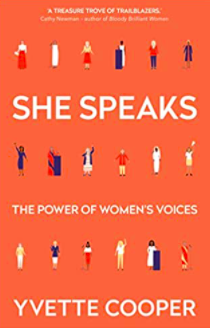
She Speaks: The Power of Women's Voices, by Yvette Cooper, reviewed by Benjamin Goodwin
The north London constituency is not without its problems, admits David Lammy, but it remains a destination second to none…
There is no excerpt because this is a protected post.

The Establishment has been wrong before, notes Tim Congdon. Is it so crazy, he asks, to think that it might be wrong again?
Rotherham's MP, Sarah Champion, chair of an important parliamentary group on adult survivors of child sexual abuse, wants to see some change at the MoJ
The political philosopher ponders policy, populism and the changed landscape of European politics