The storming of the Capitol on January 6. Tyler Merbler
In the social media age, the amplification of a constant drumbeat of false and harmful messaging that can radicalise its recipients, argues Damian Collins
In Digital Confidential, Damian Collins delves into the growing tension between tech giants' seemingly limitless power and the urgent needs of democracy.
A 1964 Ku Klux Klan meeting led by Clarence Brandenburg in Hamilton County, Ohio and recorded by a Cincinnati television station has become central to two big debates this year. Firstly, should President Donald Trump have been impeached for his part in an insurrection at the US Capitol on the 6 January, which sought to prevent the Congress confirming the election of Joe Biden as America’s next President. Then, whether Facebook and Twitter right to de-platform him by closing down his social media accounts.
Following that meeting of the Klan, Brandenburg was convicted for advocating unlawful violence after a racist and anti-Semitic speech calling for “revengeance” and for people to march on the Washington DC political establishment that “continues to suppress” white people. He appealed his conviction in a case that was eventually heard by the Supreme Court in 1969, which found in his favour and ruled that the First Amendment of the Constitution protected a citizen’s freedom of speech rights - unless that speech is “directed to inciting or producing imminent lawless action and is likely to incite or produce such action”. Brandenburg’s defence rested on the lack of immediacy and the uncertainty over whether people would have acted on his words.
Unsurprisingly, Facebook’s definition of harmful speech on its platform is based on this ruling. In the last year they have removed content calling for people to set fire to 5G mobile phone masts, on the false claim that their signals spread COVID-19, and also removed posts dangerously advocating the use of poisonous substances as a panacea against the virus. However, they took no action against the campaign by Donald Trump and his supporters which asserted that the Presidential election had been stolen from him, a movement that led to the deaths of five people in violent scenes when they stormed the Capitol on 6 January.
When Trump’s former chief strategist Steve Bannon used Facebook to call for the decapitated heads of public officials who weren’t “with the program” to be placed on spikes, and cited how in the American Revolutionary Wars people were executed for collaborating with the British, Mark Zuckerberg responded that it “did not cross the line” that would require his account to be suspended.
In the period from the election night on 3 November 2020 until the insurrection, Donald Trump made over four hundred comments falsely claiming the election result was fraudulent. He called for “wild” protests and told supporters at his ‘Save America’ rally on 6 January, “We fight like hell. And if you don't fight like hell, you're not going to have a country anymore.” At the same event his personal lawyer, former New York City Mayor, Rudy Giuliani, called for “trial by combat” and his son Donald Trump Jr. warned members of the Congress, “We’re coming for you.” In February, at Donald Trump’s impeachment trial on the US Senate, Democrat Congresswoman Diana DeGette recalled the words of one of the protestors: “the attack was done for Donald Trump, at his instructions and to fulfil his wishes.”
According to Professor Richard Wilson, from the University of Connecticut School of Law and author of ‘Incitement on Trial’, as a result of Trump’s actions that day, “He should be criminally indicted for inciting insurrection against our democracy.” However, Mark Zuckerberg at Facebook and Jack Dorsey at Twitter didn’t need to wait for a decision of the courts. Protected in law from liability for any action they take to moderate speech on their platforms, they kicked Trump off. I believe they should have acted well before 6 January to prevent their systems being used to boost the ‘Stop the Steal’ campaign. In the social media age, we need to be concerned not just about the immediate advocacy of an unlawful act, but the increasing amplification of a constant drumbeat of false and harmful messaging that can radicalise its recipients. There’s also the legitimate question about whether it should be left to the chief executive of a social media company alone to decide when to silence the President of the United States.
However, concerns about whether social media is being used to incite harmful behaviour go well beyond politics. These platforms have been used to coordinate genocide in Myanmar and lynchings in India. In 2020, we saw declining levels of trust in Europe in particular, in the likely efficacy of a COVID-19 vaccine, following waves of anti-vax conspiracy theories online. In recent years there have been significant increases in self harm amongst pre-teen girls, reported hate crimes, problem gambling and deaths from drugs. Inducements for all of these are widespread across the internet.
I’ve advocated since the publication of the Digital, Culture, Media and Sport select committee report on Disinformation and fake news in 2018 that ...
Subscribe to The Mace
Join the member community shaping British politics and stay ahead of
what's really happening in the world of politics and public affairs,
with expert analysis, breaking news, and insider insights from
Westminster and Brussels. The Mace is the leading news source and
resource for the government affairs industry, offering required
reading and lobby intelligence for professionals.
To see what you are missing out on by not subscribing to The Mace, click here to download our full membership info-pack. This includes
having no paywall on op-ed content or profiles/interviews, allowing
professional profiles to be read with maximum impact and visibility by
government, special advisers, MPs, peers, civil servants, and policy
and political decision-makers.
Meta agrees to overhaul its EU ad model, offering clearer data-sharing choices for users after regulators ruled its previous system breached competition rules.
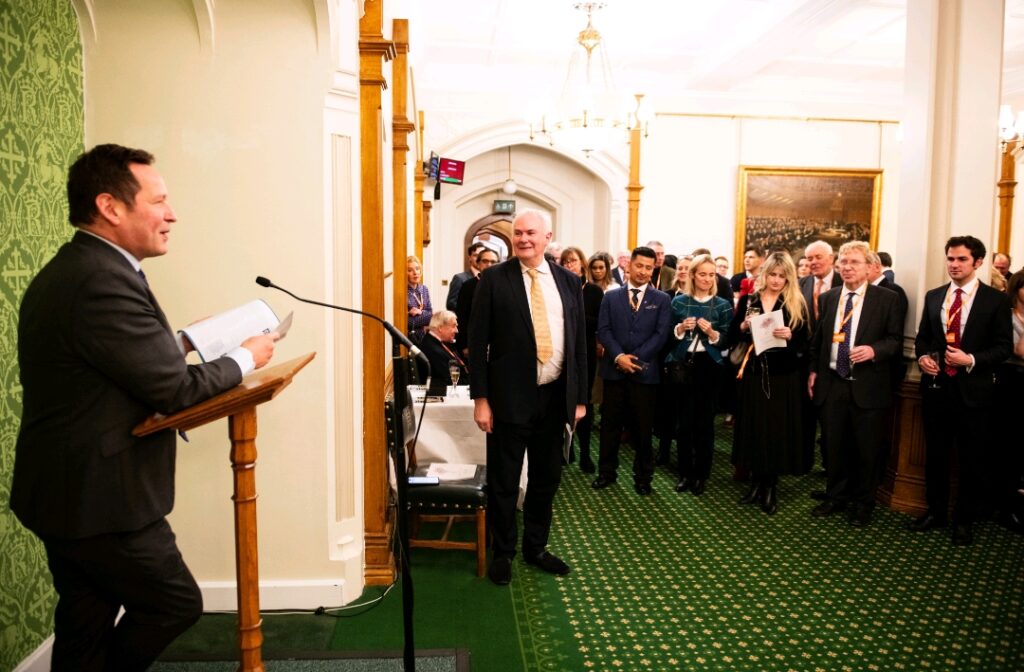
MACE marked its 5th anniversary with a high-profile Commons reception of politicians, diplomats, media figures and lobbyists, launching its influencers report
From self-lacerating memoir to by-election madness and a Labour Together takedown, The Mace’s literary editor Christopher Silvester rounds up the latest political books.
Three former Conservative MPs, including ex-deputy chair Jonathan Gullis, defect to Reform UK as the party capitalises on Tory unrest and declining support.
The government plans to end most taxi travel for asylum seekers attending medical appointments, replacing it with public transport and tightening Home Office oversight.

The resignation of Andriy Yermak after anti-corruption raids disrupts Ukraine’s leadership and triggers uncertainty across Europe during a critical phase of the war.
After weeks of tax rumour and expectation-setting, the 26 November Budget landed as a welfare-first package that lifts the benefits cap but tightens the screw on household incomes,