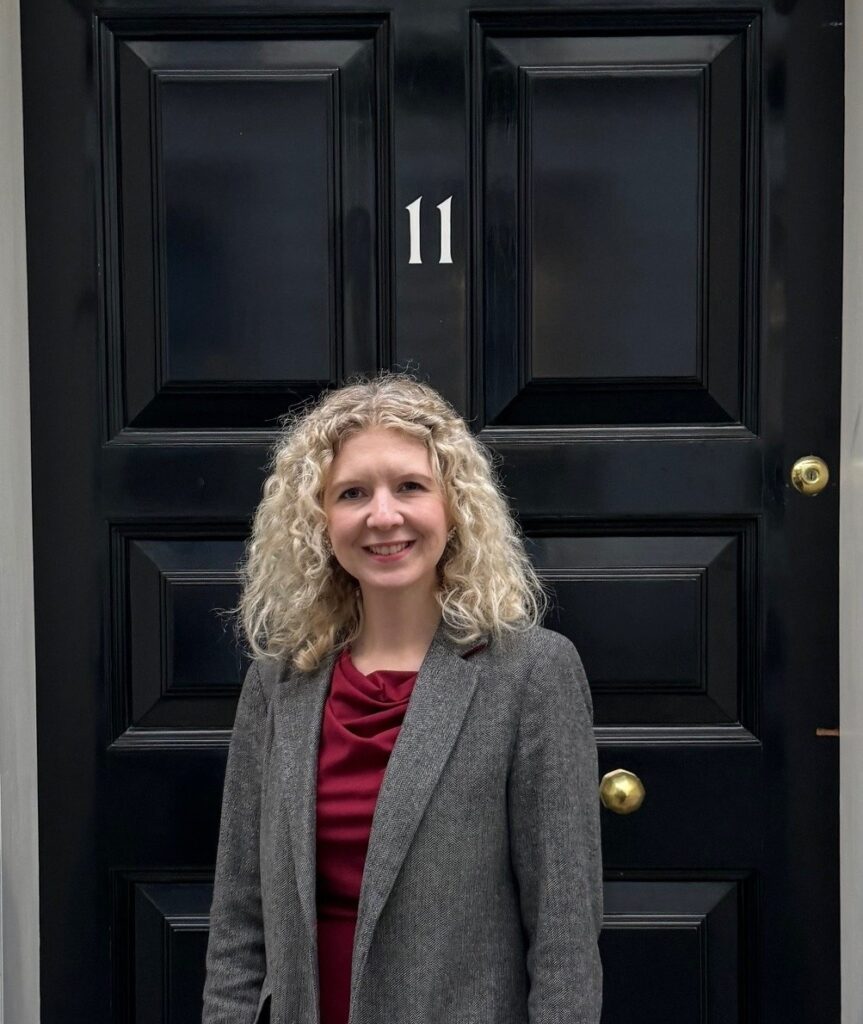
Stef Kenyon discusses the pressures, personalities, and politics that shape the maritime industry.
“I came to public affairs via a more unconventional route,” says Stef Kenyon. After studying and spending time in Brussels and Kazakhstan, she joined the British Group of the Inter-Parliamentary Union — a role she describes as a “crash course in parliamentary process, diplomacy and international engagement.” Working directly with MPs, ministers and officials across the full spectrum of policymaking clarified her direction. “I wanted to be closer to the action,” she says, shaping legislation, building relationships and “telling the story behind the issues.”
That blend of policy, diplomacy and narrative has defined a career spanning pensions, insurance and now shipping — sectors where regulation, economics and global dynamics intersect.
The UK Chamber of Shipping represents the country’s shipping industry. As a sector underpinning international trade and supply chains, its interests are inherently global — and increasingly shaped by rapid regulatory and geopolitical change.
For Kenyon, that pace is the central challenge. “The sheer volume and speed of regulatory change,” she says, from decarbonisation and security to trade and safety. Each is complex in its own right; taken together, they create a system that is constantly shifting. The task is not just engagement, but perspective. “Maritime isn’t a niche sector,” she says — it is “a global industry underpinning almost everything the country relies on.” Ensuring that message cuts through is a core part of the role.
Her view of in-house advocacy reflects that breadth. She describes it as “helicopter public affairs” — representing an entire industry across Parliament, media and stakeholders. The advantage lies in understanding “the pressures, personalities and politics” that shape outcomes, and in building relationships over time that “genuinely shift” them.
Her career highlights reflect both creativity and impact. The #PensionAttention campaign — which included collaborating with Big Zuu on a rap about pensions — reached over 20 million people and brought together multiple organisations and providers.
More recent work has focused on regulatory detail. Engagement on a statutory instrument related to maritime emissions brought together policy expertise, member insight and parliamentary strategy. While the regulations themselves were not changed, the campaign succeeded in raising industry concerns and building political support — a reminder that impact is not always defined by immediate legislative outcomes.
Her perspective on artificial intelligence is pragmatic, if cautious. “Working smarter, not harder,” she says, recognising its value in overcoming the “blank page.” But the fundamentals remain. “AI can summarise a debate,” she notes, “but it can’t replace political instinct… or relationships based on trust.” Public affairs, she argues, remains “a people business.”
Her expectations of agencies reflect a similar emphasis on substance. The most valuable partners are those willing to act as a “critical friend” — challenging assumptions and bringing fresh perspectives, rather than simply presenting polished outputs.
Her leadership philosophy is structured but human. “Set the direction, empower people to deliver, and remove obstacles,” she says — alongside creating teams where “everyone has a voice.” She also reflects “sometimes it’s good to remember we are saving PDFs, not lives.”
That balance extends outside work. With a young child, much of her time is shaped by family life — “everything is a question,” she says.
Watching legislation you have worked on being debated in the chamber can be “nerve-wracking, infuriating and exhilarating” — a combination that captures the unpredictability of the profession.
Quick-fire Q&A
How did you start in public affairs?
“Through the Inter-Parliamentary Union… a crash course in diplomacy and policy.”
What policy issue keeps you up at night?
“The speed and volume of regulatory change in maritime.”
What’s the appeal of in-house advocacy?
“‘Helicopter’ public affairs… representing an entire industry.”
Proudest achievement?
“#PensionAttention… and raising £100m during Covid.”
Best piece of advice?
“Know when to step back… trust your team.”
View on AI?
“It helps you start… but can’t replace instinct or relationships.”
Advice for agencies?
“Be a critical friend… challenge assumptions.”
Leadership philosophy?
“Set direction, empower people, remove obstacles.”
What do people get wrong about public affairs?
“That it’s just spin… it’s about evidence and storytelling.”
How do you unwind?
“Family time… and learning through my child’s curiosity.”
Any memorable media moment?
“Talking about ‘Boaty McBoatFace’ without saying it.”