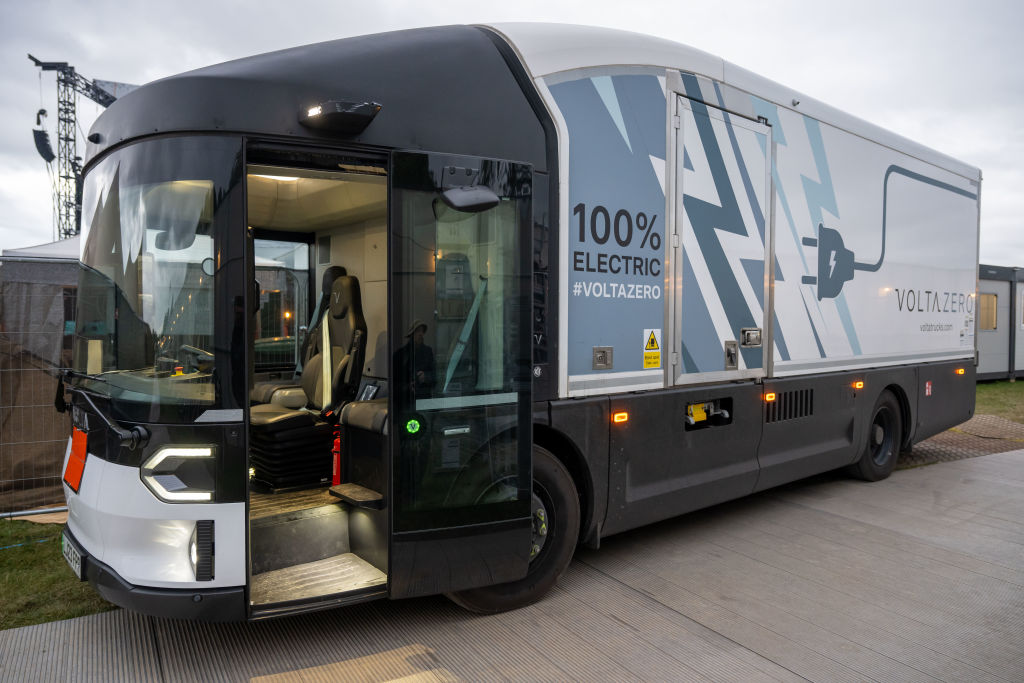
Trade body describes the Government’s new electric HGV plan as a ‘monumental challenge’
Oliver Dean | 17th February 2026 | Jobs, Trade Associations, Uncategorised
Despite government plans to reduce costs of electric HGVs by up to £120,000, demand has still fallen (Photo by Matthew Horwood/Getty Images)
With only 1 in 70 new HGV's being electric, the government must assist with infrastructure investment says industry leader
The UK Government’s decision in January to launch a package to slash the cost of electric lorries has failed to prevent a downturn in the market, figures released by the trade body Society of Motor Manufacturers and Traders (SMMT) on Monday reveal.
Ministers announced an expansion of the Plug-in Truck Grant earlier this year, extending support for zero-emission HGVs and increasing maximum grants to £120,000 for the largest electric models. The move was designed to reduce upfront costs of battery-powered trucks and accelerate fleet decarbonisation ahead of the planned 2040 net-zero target.
At the time, the Department for Transport framed the measure as a “boost for British business,” arguing that lowering capital costs would improve cash flow for operators and stimulate investment in new vehicles.
However, new industry data suggests the incentive has not translated into overall market growth. Registrations of HGVs have dropped by 10% over the past year. Appearing on BBC's Today Programme on Tuesday morning, Mike Hawes, OBE, chief executive of the influential Society of Motor Manufacturers and Traders (SMMT), spoke out about the impact that this policy will have on the industry saying the Net Zero targets had created a very difficult climate for the motor manufacturing industry.
Whilst the number of electric trucks last year actually doubled, electric HGVs still only represents about one in 70 of trucks that were registered. "So we’ve got a huge distance to go because the policy is that we’ve got to have all new trucks, zero emissions that are sold, by 2040. And that's 14 years away.”
Mr Hawes said this target "was not just going to be a challenge, but a monumental challenge."
"What we saw in the car industry, when the first mainstream electric car was released 15 years ago, we’re now sitting at around 25%. The key issue for trucks, though, is that operators know, down to half a pence per mile how much it's going to cost for them to do a delivery, to do an operation. Once that cost is beneficial, in terms of electrification, then the switch can happen quickly. For that, however, you need to get the costs of the trucks down, we need to get the costs of energy down so it's more comparable to diesel, and you need to get the infrastructure there because it’s woefully short at the moment."
Despite the obstacles ahead when it comes to electric HGVs, Hawes said that the challenge could be only be met if investment in infrastructure was greatly improved with the lack of depot charging availability a significant problem:
"We talk of some very generous grants there at the moment for truck purchases, but one of the biggest obstacles is that you can’t run a truck unless you can charge it from your depot, so you need to get those grid connections and for some of them, people have quoted 10 years for delivery. You also need to get the road network, the charging network on the roads improved. The number of dedicated truck chargers is probably less than 10, it’s in single figures."
“But also we’ve got to think about all options, it's not just about electrification. Hydrogen might be part of that future, and we don’t have a hydrogen network in the UK, and if you want to keep all options open, because the enemy here is carbon, think about hydrogen as well”
The fall in demand is seen to be a response to the general economic situation, rather than a rejection of electrification itself. Operators continue to face tight margins, rapidly changing fuel prices, rising insurance costs and reduced business confidence.
While zero-emission HGV uptake is increasing from a low base, it remains a small fraction of total registrations. For many firms, the business case for electrification still hinges on charging infrastructure availability.
The government’s strategy has focused on providing long-term policy certainty, combining grants with consultation on the future regulatory framework for zero-emission trucks. But the latest figures reflect the challenge of stimulating growth and engagement amid a period of economic uncertainty.
For policymakers, the challenge now is whether additional fiscal support, infrastructure investment or broader economic recovery will be needed to reverse the downward trend, or whether the current dip reflects a cyclical pause rather than a structural problem....
Subscribe to The Mace
Join the member community shaping British politics and stay ahead of
what's really happening in the world of politics and public affairs,
with expert analysis, breaking news, and insider insights from
Westminster and Brussels. The Mace is the leading news source and
resource for the government affairs industry, offering required
reading and lobby intelligence for professionals.
To see what you are missing out on by not subscribing to The Mace, click here to download our full membership info-pack. This includes
having no paywall on op-ed content or profiles/interviews, allowing
professional profiles to be read with maximum impact and visibility by
government, special advisers, MPs, peers, civil servants, and policy
and political decision-makers.
The Burnham administration has unveiled an ambitious new vision for Britain's school system. Mace asks leaders across the education sector for their verdict.

As a parliamentary Boz of modern times, Quentin Letts has recently found himself under fire in the Commons press gallery. He tells us why sketch writers don't need
The news that former Home Secretary Sir Grant Shapps has failed to make the new Tory candidate list has put fear into dozens of former Conservative MPs. Whether
Andy Burnham has promised the ‘biggest rebalancing of power our country has ever seen’. The Mace investigates what industry insiders think of his vision.