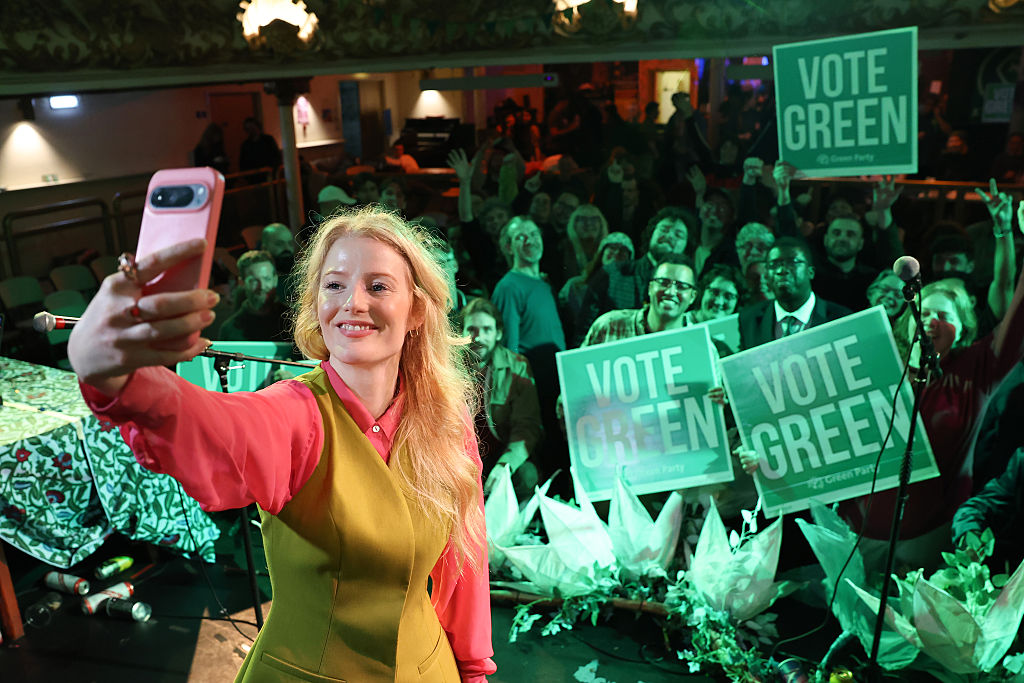
LIVERPOOL, ENGLAND - SEPTEMBER 30: Prime Minister, Keir Starmer at the end of his speech during the Labour Conference at ACC Liverpool on September 30, 2025 in Liverpool, England. Keir Starmer addresses Labour Conference for the second time since the party came to power, announcing the launch of NHS Online in 2027 to modernise the health service. (Photo by Jeff J Mitchell/Getty Images)
Optimism, strategy and late-night gossip: Beverley Nielsen shares her experience of Labour’s four-day conference in Liverpool.
Arriving in Liverpool, it’s hard not to be struck by its grimy glamour and the brash hubbub of an eager, smart young population pitching into the city’s vast array of pubs, clubs, restaurants and live music. I was among over 20,000 delegates attending the Labour Party’s biggest conference to date. Stretching over five days, it sometimes felt like the political equivalent of an Ironman triathlon, requiring every bit as much stamina, while providing a £30 million boost to the local economy.
A relative newcomer to Labour’s membership ranks, I’ve been lured in by devolution, opening up economic opportunities as power is pushed down to local places to grow their economies from the grassroots up. As the delegate for West Worcestershire, I was able to launch into more than 600 fringe events, keynote speeches and networking opportunities.
With swirling speculation over the leadership challenge facing Sir Keir Starmer, I wondered what the mood would be like among the party faithful. It didn’t take long to realise that, in general, it’s remarkably upbeat. Bumping into Liam Byrne MP, Chair of the Business and Trade Committee, just after the Leader’s speech, it was clear he thought it had the right ingredients to silence the rumours: vision, charm, anecdotes and community recognition. Members were on their feet whooping. A young Warwickshire delegate beside me was confident Keir would see out the term. “He’s popular amongst sitting MPs, we understand it was never going to be smooth sailing and right now is the hardest point of the term. As a Party we don’t tend to take our leaders out. I suspect it will be his choice if he goes.” But not everyone agreed. Outside the hall, rumours lingered, including one that Keir himself had nudged Andy Burnham to float a leadership bid as a way of forcing the issue.
With local elections due in May 2026, poor internal communications remain a problem. Members complain about how little media coverage is given to Labour’s early achievements and policy announcements. These include free childcare for nine-month- to four-year-olds, free school meals for 100,000 children, breakfast clubs, trade deals with India, the US and EU, Clyde shipbuilding following Norwegian frigate orders, and a new goal to get 75% of young people into higher education, further education or gold-standard apprenticeships by the age of 25.
Would Keir win this battle for the heart of Labour, I asked Will Hutton, author and contributor to The Observer. Before answering, he reminds me of our first meeting, “a rather prolonged and (he claims) flirtatious lunch in 1989 at MIPCOM in Cannes.” Moving into professorial mode, he lists three possible leadership options: “Ed Miliband, Shabana Mahmood and Wes Streeting.” How did he find the mood at conference? “Thoughtful. All my adult life the Tories have been the natural party of government, with an ancestral memory of class... Stalwarts of the community, like my aunt whose wine and cheese parties everyone went to. Reform can never inherit that mantle. Thirty percent of the population are very angry and want to protest, but it’s not enough and they may simply end up dividing the right-wing vote. Danny Kruger foretells this. Business may not like Labour, but they dislike Reform even more.”
Beverley Nielsen with Mace editor-in-chief William Cash
I left the Tory Party when it seemed too much faith in animal spirits and light-touch regulation allowed apex predators to exploit the vulnerable—culminating in scandals and the Global Financial Crash. The final straw was the fiscal chaos of Liz Truss.
Labour’s focus on public–private collaboration to drive growth—via state-led infrastructure and innovation—offers a different path. Mariana Mazzucato’s The Entrepreneurial State shows how public funding can enable collaborative innovation, like ecosystems in rainforest canopies or coral reefs.
So how was Labour doing, I asked some businesses attending? Rain Newton-Smith, Director General of the CBI, stated, “the Chancellor’s speech gave confidence and went down well with its focus on fiscal stability and sticking to the rules, seen as critical by business, all about budgets and delivery.” Another business involved in delivering large IT projects saw opportunities to bring far greater efficiencies to government. In the procurement process—long a bugbear—timelines could be speeded up and costs reduced. As UK government spends over £340 billion on public procurement a year, representing only a third of total public sector spending, the upside potential is huge. One professor noted, “It’s so difficult to run government. It’s not like being a CEO, but more like running your renewal project using a washing machine. To coordinate this washing machine, you’d need either i) a strategy unit coordinating across government departments; ii) high-level appointments, as undertaken by Cameron in government; iii) clear messaging providing understandable cohesion. As long as these aren’t in place, ...
Subscribe to The Mace
Join the member community shaping British politics and stay ahead of
what's really happening in the world of politics and public affairs,
with expert analysis, breaking news, and insider insights from
Westminster and Brussels. The Mace is the leading news source and
resource for the government affairs industry, offering required
reading and lobby intelligence for professionals.
To see what you are missing out on by not subscribing to The Mace, click here to download our full membership info-pack. This includes
having no paywall on op-ed content or profiles/interviews, allowing
professional profiles to be read with maximum impact and visibility by
government, special advisers, MPs, peers, civil servants, and policy
and political decision-makers.
As AI turbocharges social media, tech giants must be held accountable says the former chair of the DCMS select committee who now leads law firm Geradin Partners' public
With Reform receiving 600 new candidate applications in 48 hours, it's clear some people still want to become an MP. Our Westminster insider reveals how to get selected
Westminster Index 2026: Edgbaston Labour MP Preet Gill reveals she's no fan of the Assisted Dying Bill but loves Jack Kerouac's On the Road. Her musical tastes range
Blakeney has welcomed former drinks company Oatly managing director Tim Knight and pro-Brexit MEP Lucy Harris, in an effort to strengthen their position, the public affairs and strategic
Benjamin Wegg-Prosser, who co-founded the lobbying firm Global Counsel alongside Peter Mandelson has today resigned following significant backlash regarding the firm’s link to Jeffrey Epstein.