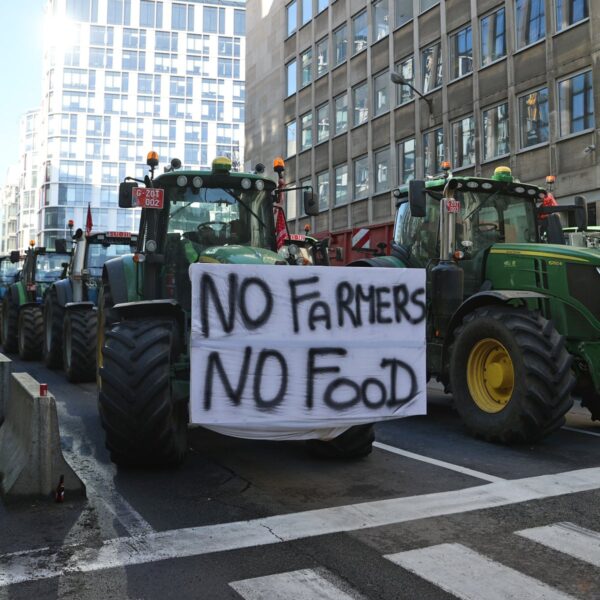
Thousands of farmers descended on the streets of Strasbourg and other European cities this week ahead of a key vote in the European Parliament on the controversial trade deal between the European Union and the Mercosur bloc of South American countries.
Demonstrators driving tractors and waving national flags gathered near EU institutions, aiming to put pressure on lawmakers as the long delayed agreement edges closer to a decisive parliamentary moment.
Farmers from France, Italy, Belgium, Ireland and Poland were among those mobilised by national unions and agricultural organisations. Convoys of tractors blocked roads leading to Strasbourg, while protests were also held in national capitals and regional centres. Local authorities reported large scale participation over several days as farming groups sought to show the depth of opposition across multiple member states.
The demonstrations follow provisional backing for the EU Mercosur agreement by a majority of EU governments earlier this month, a move that sharpened resistance among farming communities. Several countries including France, Austria, Hungary, Ireland and Poland have raised concerns about the deal’s agricultural impact, exposing deep divisions within the bloc even before the European Parliament casts its vote.
In Ireland, thousands of farmers marched through Athlone earlier in January, warning that increased imports of South American beef could have severe consequences for domestic producers. Similar concerns have been raised by cattle farmers in France and Poland, where agricultural groups argue that price pressure from imports would further strain an already fragile sector facing rising costs and tighter environmental rules.
Belgian farmers have also joined the cross border mobilisation, with tractor convoys travelling from Flemish towns towards Strasbourg. The coordinated nature of the protests has highlighted the extent to which opposition to the Mercosur deal has unified farming groups across national lines, turning the issue into a pan European political headache.
At the centre of the dispute is the fear that the agreement would allow large volumes of agricultural products such as beef, sugar and poultry into the EU from Brazil, Argentina, Paraguay and Uruguay. Farmers argue these imports are produced under standards that differ from EU environmental and animal welfare rules, creating what they see as unfair competition in European markets.
The EU Mercosur agreement has been under negotiation for nearly 25 years and would create one of the world’s largest free trade areas, linking the EU with a market of more than 260 million people in South America. Supporters within the European Commission and several member states argue it would benefit European exporters of cars, machinery and chemicals, while strengthening geopolitical ties with the region.
Opposition from farmers has repeatedly slowed progress on the deal, contributing to delays in signing and ratification. Previous waves of agricultural protests across Europe have already forced EU leaders to tread carefully on trade policy, particularly as rural discontent has become a potent political force in several member states.
The European Parliament vote, which could determine whether the agreement proceeds or faces further legal scrutiny, is being closely watched by governments, trade officials and farming unions alike. With tractors still lining streets near EU buildings and protests continuing ahead of the vote, lawmakers face mounting pressure to reconcile trade ambitions with the political realities of Europe’s agricultural sector....
Subscribe to The Mace
Join the member community shaping British politics and stay ahead of
what's really happening in the world of politics and public affairs,
with expert analysis, breaking news, and insider insights from
Westminster and Brussels. The Mace is the leading news source and
resource for the government affairs industry, offering required
reading and lobby intelligence for professionals.
To see what you are missing out on by not subscribing to The Mace, click here to download our full membership info-pack. This includes
having no paywall on op-ed content or profiles/interviews, allowing
professional profiles to be read with maximum impact and visibility by
government, special advisers, MPs, peers, civil servants, and policy
and political decision-makers.