Cavendish report shines a backstage light on the reality of the Green Party
Oliver Dean | 22nd February 2026 | Lobbying, Politics
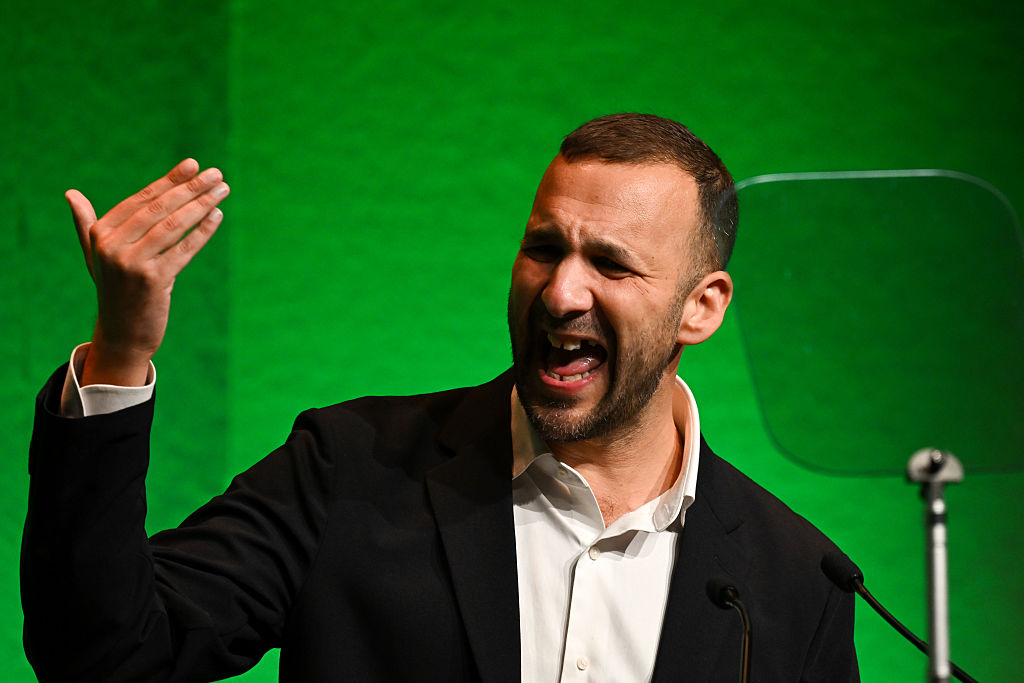
Zack Polanski at the 2025 Green Party conference (Photo by Finnbarr Webster/Getty )
With the Green Party polling ahead of Labour in Gorton and Denton, PA agency Cavendish recommends a 'more nuanced' C-Suite approach to political risk
Public affairs agency Cavendish have published a political monitoring report, Green Gains, on the rise of the Green Party, subtitled: 'What the rise of eco-populism means for policy, politics and corporate reputation." With the Green Party narrowly polling ahead of Labour in Gorton and Denton, the insurgent party is now seen as an existential threat to the Labour Party.
With the Green Party now having more members than Labour and the latest polls making local plumber and councillor Hannah Spencer a possible winner in the Gordon and Denton by-election on 26th February, the 15 page report is especially timely. Spencer in a close neck fight with Reform's Matt Godwin of GB News fame whilst Labour appear to be drifting.
But how does Cavendish's monitoring analysis stack up?
The elephant in the room is addressed first. The British left is fragmented. What Farage has succeeded in doing with Reform on the right, Polanski is emulating with the Greens on the left. The report details an important statistic - that under Polanski’s leadership, Green Party polling has risen from 10 per cent to roughly 15 per cent, with some polls putting them at 19 per cent.
Simultaneously, membership figures, brand recognition and confidence have risen too. Indeed, the two-party system appears to have disappeared. The left of British politics was once ripe for Labour’s taking. Bar the communists and such who sit on the extreme end of the spectrum, many who proclaimed to have a broadly left-of-centre outlook could find their home in Labour.
But as Labour routinely fails to meet expectations in office, with figures such as the Prime Minister proclaiming that he recognises that people’s conditions have not improved, the Greens have emerged as a contender. But, as Cavendish lays clear, the concern for businesses is not a Green government, it is policy drift and a government that is more reactive than it is strategic.
But, perhaps the most interesting point of discussion in the report is the question of ‘who’s voting Green?’. As Cavendish highlights “the Greens’ increase in popularity is not evenly distributed across the electorate, or the UK.” Voters to the left of traditional Labour are “disaffected” about the party’s move towards the centre, especially with their responses to issues such as Gaza, climate policy and welfare. Men aged 18-24, and women aged 25-49 are the demographics wherein the Greens enjoy the most support.
Whilst Labour’s woes have contributed to this in part, the other factor to consider is “The Polanski effect.” The foundational approach of Polanski is evident, and raised in the report. “Build a movement first, do the policy detail next.” Such an approach is clear to see. Time and again, when pressed on specific policy proposals, the Greens often fall short. Aside from ‘tax the rich’, Polanski nor his colleagues seem to have many concrete ideas.
Yet, the movement is growing. His use of digital media, as opposed to traditional media, and unorthodox campaign strategies - such as hiring out a London nightclub for a fundraiser - have all contributed to him appearing as a different breed of politician. Many have compared him to Mamdani in New York, a slick and youthful politician who will change the system.
Looking into 2026, continued Green Party success will not come from the outright winning of councils - though if this happens it will of course be a boost to the party’s image. Instead, the report notes that the Greens will seek to gain leverage and disrupt fragmented institutions at every opportunity. This lends itself, in part, to the Greens’ lack of concrete policy. Diving head first into running local councils may prove to do more harm than good.
Indeed, such rapid success may contribute in part to their downfall. Similarly, with Reform’s problems in local council, without sufficient time to prepare for government - either national or local - the Greens may find themselves out of their depth. Sniping from the sidelines, therefore, and offering criticism where it is necessary is arguably more helpful than being in power.
The reaction from within Labour has been striking. As Cavendish notes, the “Greens are already influencing Labour behaviour.” MPs with seats in inner-city and metropolitan areas are reporting “growing concern about their vulnerability to left-wing challengers” and as a result, many are seeking to lobby government policy to counter this rise. Whilst many in Labour are concerned over Reform, perhaps the existential threat comes from the Greens.
With respect to what this means for businesses and trade bodies, the report makes it clear. It notes that “influence is no longer confined to government.” Local government, devolved regions and public campaigns all hold significant weight when it comes to debating policy. Secondly, reputational risk is now “more acute,” and even when government policy is settled local pressures can “delay or derail delivery.” Finally, engagement with decision makers ...
Subscribe to The Mace
Join the member community shaping British politics and stay ahead of
what's really happening in the world of politics and public affairs,
with expert analysis, breaking news, and insider insights from
Westminster and Brussels. The Mace is the leading news source and
resource for the government affairs industry, offering required
reading and lobby intelligence for professionals.
To see what you are missing out on by not subscribing to The Mace, click here to download our full membership info-pack. This includes
having no paywall on op-ed content or profiles/interviews, allowing
professional profiles to be read with maximum impact and visibility by
government, special advisers, MPs, peers, civil servants, and policy
and political decision-makers.