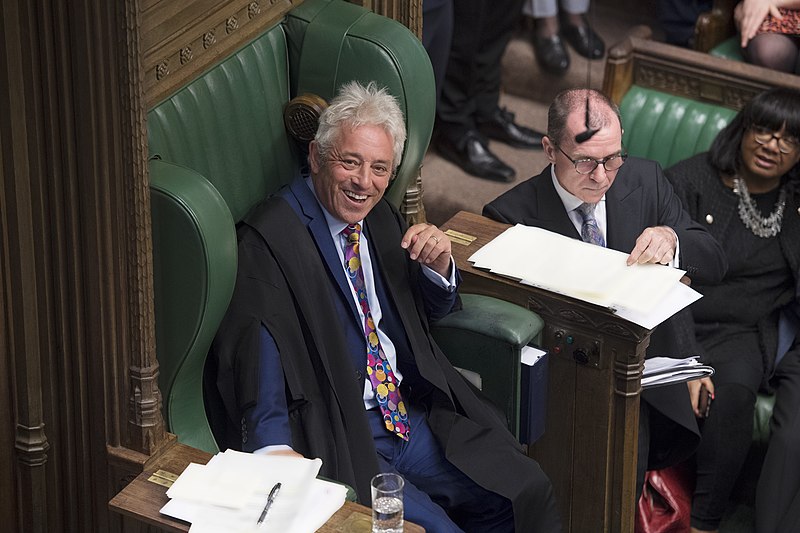
Rt Hon John Bercow MP announces his retirement as Speaker of the House of Commons
Bercow may be long gone but bullying is still very much alive in the House of Commons, says Adam Solomons
While Speaker of the House of Commons, Bercow mismanaged a spate of allegations of bullying and harassment across the house. The inquiry by Dame Laura Cox, in 2018, showed Parliament’s processes for dealing with such accusations to be lax and ineffective. And there was another elephant in the room – Bercow’s own conduct.
Accusations against him were revealed in a series of explosive Newsnight reports in early 2018, which saw numerous former subordinates detail a campaign of aggressive and unprofessional behaviour by the former Speaker. The most egregious, but by no means exceptional, involved Bercow’s former private secretary Kate Emms, who in 2011 left the Speaker’s Office and later sought treatment for post-traumatic stress disorder. Another of Bercow’s former private secretaries, Angus Sinclair, reported having pieces of Bercow’s phone hit him when the Speaker threw it onto the table in front of him. Since that reporting, three of Bercow’s most senior subordinates have lodged formal complaints with the House.
It’s been over a year since John Bercow left Parliament. But, in spite of the new speaker Sir Lindsay Hoyle's best efforts, the culture in the House hasn't changed much.
***
The current Speaker, Sir Lindsay Hoyle, was elected five weeks beforehand on the back of his good standing across the House and his promise to clean up Parliament’s bruised reputation as a toxic workplace.
Since his election, Hoyle has gone to great lengths to undo the bullying culture in the House: he implemented all three recommendations made in Dame Laura Cox's report, encouraged all staff and MPs to take part in the ‘Valuing Everyone’ training scheme and has maintained a 'zero tolerance policy' on bullying. So said a spokeswoman for the Speaker's Office. And after only two months in the job, Sir Lindsay told a room full of journalists: “The bullying culture is over.”
Unfortunately, according to the staff of a number of MPs, Sir Lindsay’s vision hasn’t quite materialised.
A young female staffer in the office of a Northern Labour MP said: “Parliament is one of the most daunting environments I have experienced. In the two years since I first arrived, the feeling hasn’t subsided. I don’t think I ever feel comfortable walking around.
“When you’re in Parliament, it’s often the case that some person of power walks past and whoever you’re with will say something along the lines of, ‘Oh he’s a bad egg’ [or] ‘He’s horrible to his staff.’”
Staff workplace wellbeing still rests too heavily in the hands of the MPs
On the subject of Parliament’s much-criticised capacity for dealing with bullying and harassment claims, optimism is also rare. Upon taking the Speaker’s chair, Sir Lindsay gave Parliament’s trade unions their first ever seats on the House of Commons Commission, the powerful administrative body which oversees the everyday management of Parliament, as well as major projects such as the renovation of the estate. The Speaker has also made a point of confronting MPs whose staffers are seen on the estate, in line with union appeals for genuine remote working during the coronavirus pandemic.
But despite these reforms, staff members widely believe that their workplace wellbeing still rests too heavily in the hands of their employers – the MPs whose offices they work in. As well as the elected representative for which the office exists, MPs are the formal employers of all office staff, their internal HR contact, and their accounts manager. When a staffer needs to take time off, it’s the MP who has to sign off and process it.
For the young and impressionable office staff who make up the bulk of MPs’ offices – many are in their early twenties and some are teenagers – this is fraught with difficulty. A simple request for sick leave can be interpreted as a betrayal and a question mark in their dedication to the cause. With workloads throughout Parliament multiplying many times over since the start of the coronavirus pandemic, several staffers I spoke to have struggled to balance their own mental health needs with a ballooning email inbox full of worried constituents – and an MP expecting the work to be done.
One staffer in a South West MP’s office explained their unusual employment structure was itself conducive to a poor work environment.
“Some MPs are better managers than others and the employment structure fails to mitigate against that,” he said. They favour a system using a “pool” of MPs’ staffers who can be shuffled in the event of internal office difficulties and regulated centrally by the House. That plan was rejected by the Commons over a decade ago – and is unlikely to gain the favour of the current Speaker.
Jenny Symmons, chair of GMB MPs Staff Branch, agreed it was an institutional challenge needing a deeper solution. “The underlying issue is that MPs are individual employers. They are their own bosses. They know they are to an extent unaccountable, so until that is changed staff will not be properly protected.”
Unsurprisingl...
Subscribe to The Mace
Join the member community shaping British politics and stay ahead of
what's really happening in the world of politics and public affairs,
with expert analysis, breaking news, and insider insights from
Westminster and Brussels. The Mace is the leading news source and
resource for the government affairs industry, offering required
reading and lobby intelligence for professionals.
To see what you are missing out on by not subscribing to The Mace, click here to download our full membership info-pack. This includes
having no paywall on op-ed content or profiles/interviews, allowing
professional profiles to be read with maximum impact and visibility by
government, special advisers, MPs, peers, civil servants, and policy
and political decision-makers.
EU governments approve targeted revisions delaying the deforestation regulation, easing compliance demands while keeping core environmental safeguards in place
Thailand’s baht hits multi year peak, squeezing exporters and forcing policy makers to juggle currency stability, trade competitiveness and fragile economic recovery