The Commission’s three-pronged plans for a new Europe have returned from hibernation - and are a sleepwalk into bad policy
The European Commission promised a transformation of EU politics when Ursula von der Leyen and her colleagues came into office in late 2019. Of course, no one expected the continent would be engulfed by a pandemic. But as the coronavirus crisis recedes over the summer, ambitious plans for transition will regain the spotlight of European politics.
Brussels has focused on three visions in particular: ecological transformation through a Green Deal, digital transition through “strategic autonomy” and social transition to greater Europe-wide solidarity, convergence, and social justice.
The recent Social Summit in Porto put this latter topic, the European Pillar of Social Rights, back into the headlines again. As von der Leyen has said herself, “as we overcome the pandemic … it is time to also adapt the social rulebook. A rulebook which ensures solidarity between generations.”
One-size-fits-no one
The Pillar includes ideas such as a Europe-wide minimum wage, fair working conditions, greater training and educational opportunities for workers, social programs for those in need, an “adequate minimum income” (which sounds like a Europe-wide Universal Basic Income) and muchmore.
However, the European Pillar of Social Rights as presently discussed suffers from manifold defects which would harm European competitiveness, will do little good for those the Pillar tries to target, and further increases the scope of Brussels competences for reasons that seem spurious at best.
Indeed, the Pillar of Social Rights suffers, first of all, from similar problems as the Green Deal and the digital transition programs: namely, the general assumption that problems can only be solved top-down and through one-size-fits-all mega-plans. And yet, particularly in a time when Europe needs to become more competitive globally so as to get out of the COVID economic slump, it is not a good idea to further increase the size of government in the economy through centralised planning. Economic growth happens through free entrepreneurship, innovation, and creativity, not bureaucratic welfare, particularly of such a gigantic scale as a continent-wide social vision.
The wrong rights
That centralised approach - that Brussels should be more in charge of social policies than member states - also disregards the complexity of political, economic and fiscal systems within member states, all of which have crassly different conditions and systems. One of the foundations - pillars, one might say - of EU policy, as enshrined in its treaties is the principle of subsidiarity, meaning that tasks should always stay at the lowest and most decentralized level possible. The Pillar of Social Rights turns this on its head, compiling a long list of things the EU is supposedly in need of performing. It is economic and social engineering from the top-down, rather than leaving things simply to more local and national levels.
Beyond that, however, the Pillar of Social Rights brings up much more general questions of what the EU actually thinks rights are. Indeed, reading through these “social rights,” which are, according to the European Council, “human rights,” one cannot escape astonishment of what is considered a ‘right’ in Brussels. We read of a ‘right’ to “work-life balance,” a ‘right’ to “social housing,” and even a ‘right’ to “access to essential services.” Essential services in the EU termina not only include food (which is not mentioned) and water (which is mentioned), but even “energy, transport, financial services and digital communication.” What that would mean in concrete policy visions is unclear: would every European have a ‘right’ to a laptop and a Facebook account, as well as a stock portfolio? In any case, it is unknown whether a ‘right’ to digital communication is what the freedom fighters throughout world history were hoping to achieve.
Indeed, the EU’s proposal is littered with so-called “weasel words,” as Friedrich Hayek called them, words that simply sound good and can be used to justify any policy. The Pillar of Social Rights includes little policy details, little to no justifications why Brussels needs to do all of this, but many “weasel words:” all of these ideas Brussels is considering are obviously “social,” “just,” “fair,”, “inclusive,” and would expand “rights.” Who would be against that, after all? And yet, it neither explains why these policies would have that ‘just’ nature nor what the EU even means by these words. Particularly when it comes to ‘rights,’ it seems as though Brussels simply thinks that anything is a right which Brussels wants to be a right.
Arbitrary, aimless
Thus, most of the Pillar of Social Rights is arbitrary and aimless. The constant question that comes up is: why? Why is x and y a ‘right?’ Why should 60% of Europeans participate in some kind of training by 2030, which is one of the main goals of Pillar? Why 60%? And even more so, why should Brussels be in charge of this? Couldn’t individuals and companies simply figur...
Subscribe to The Mace
Join the member community shaping British politics and stay ahead of
what's really happening in the world of politics and public affairs,
with expert analysis, breaking news, and insider insights from
Westminster and Brussels. The Mace is the leading news source and
resource for the government affairs industry, offering required
reading and lobby intelligence for professionals.
To see what you are missing out on by not subscribing to The Mace, click here to download our full membership info-pack. This includes
having no paywall on op-ed content or profiles/interviews, allowing
professional profiles to be read with maximum impact and visibility by
government, special advisers, MPs, peers, civil servants, and policy
and political decision-makers.
Meta agrees to overhaul its EU ad model, offering clearer data-sharing choices for users after regulators ruled its previous system breached competition rules.
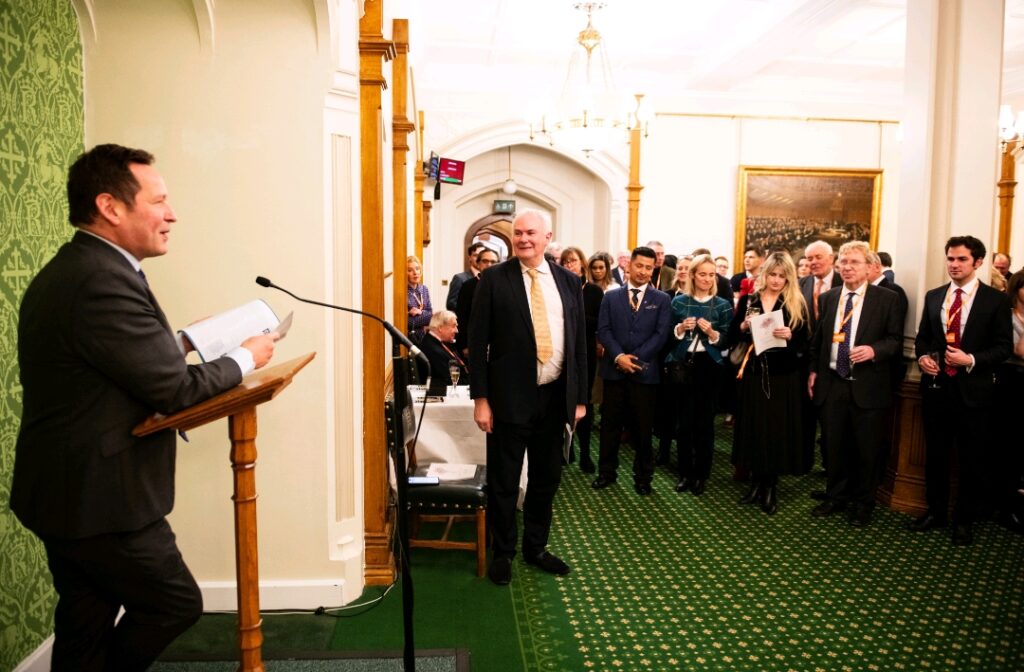
MACE marked its 5th anniversary with a high-profile Commons reception of politicians, diplomats, media figures and lobbyists, launching its influencers report
From self-lacerating memoir to by-election madness and a Labour Together takedown, The Mace’s literary editor Christopher Silvester rounds up the latest political books.
From self-lacerating memoir to by-election madness and a Labour Together takedown, The Mace’s literary editor Christopher Silvester rounds up the latest political books.
Three former Conservative MPs, including ex-deputy chair Jonathan Gullis, defect to Reform UK as the party capitalises on Tory unrest and declining support.
The government plans to end most taxi travel for asylum seekers attending medical appointments, replacing it with public transport and tightening Home Office oversight.
The resignation of Andriy Yermak after anti-corruption raids disrupts Ukraine’s leadership and triggers uncertainty across Europe during a critical phase of the war.
After weeks of tax rumour and expectation-setting, the 26 November Budget landed as a welfare-first package that lifts the benefits cap but tightens the screw on household incomes,