“I have absolutely no doubt that one day the Ukrainians will win, thanks to the bravery, the heroism, the improvisation, the genius of the Ukrainians - their country will be free,” said former PM Boris Johnson.
Nearly five years after Russia launched its illegal full-scale invasion of Ukraine, the country continues to defy expectations. Having outlasted the First World War, the conflict has demonstrated the extraordinary resilience, ingenuity and determination of the Ukrainian people – and exposed the scale of the Russian leadership’s miscalculation, after President Putin claimed Kyiv could fall in just two weeks.
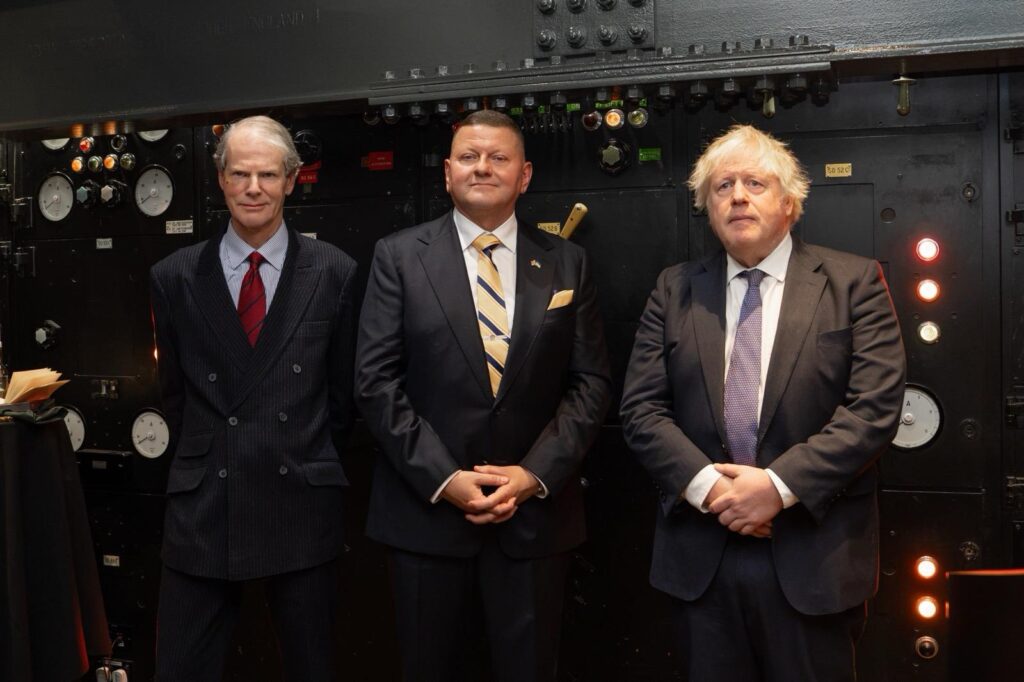
At a gathering in the Churchill War Rooms on Tuesday 23rd, former Prime Minister Boris Johnson said: “What Winston Churchill in the Second World War, and Ukrainians today, exemplify, is a spirit of absolute indomitability and refusal to give in to evil.
“Owing to General Zaluzhnyi’s brilliant leadership, Ukraine successfully repelled ‘the second strongest army’ in the world.”
Despite the controversy surrounding Johnson’s premiership, his decisive response to Russia’s invasion of Ukraine remains one of the most positively regarded and enduring aspects of his political legacy.
“What is needed to end this war is more robustness and more clarity from the West”
During his speech, the former prime minister also set out what he believed was necessary to secure Ukrainian victory. Johnson added: “What is needed to end this war is more robustness and more clarity from the West about how we see Ukraine and what we’re prepared to do to help Ukraine.
“There are certain things that we should do right now: give them the weapons and defence systems they need; take out the shadow fleet; give the €140bn of frozen Russian assets in Europe to Ukraine. And most importantly, get Ukraine into NATO.”
Alongside Johnson in the War Rooms was General Sir Adrian Bradshaw, Governor of the Royal Hospital Chelsea. Bradshaw highlighted the importance of not only helping Ukraine defend itself but also helping to deter Russia from future invasions. He said: “It is vital for our own security that we give Ukraine the means to survive as a sovereign country by defeating Putin’s attempt to take over the country, and by giving her the means to deter future aggression in military or hybrid domains.
“When this war eventually comes to some kind of agreement to cease current hostilities, if Ukraine survives as an independent country, it will be ‘PAUSE’ not ‘PEACE’ from Putin, unless we give Ukraine effective means to deter.”
Bradshaw also issued a warning regarding the possibility of NATO divisions, especially in light of tensions between the United States and Europe. He said: “For as long as the Coalition of the Willing does not include the US and other major NATO nations, it is vital that NATO avoid any risk of division within the Alliance. This would be handing Putin the gift he has desired for years.”
The Coalition of the Willing for Ukraine, co-led by France and the United Kingdom since March 2025, includes 37 countries and aims to be a coordinated political effort to strengthen Europe’s role in ensuring Ukraine’s future sovereignty and security.
Speaking beside Johnson and Bradshaw was General Valerii Zaluzhnyi, Ambassador of Ukraine to the United Kingdom and Commander-in-Chief of the Armed Forces of Ukraine (2021–2024). Zaluzhnyi sought to remind his audience of the role that Ukraine plays in not just defending itself but also the rest of Europe.
“Thanks to the Ukrainian people, millions are not killed in Europe”
He said: “Thanks to the Ukrainian people, millions are not killed in Europe. But 8,000 kilometres from Kyiv, some people are once again trying to decide the future of Ukraine and Europe in the interests of their ‘friend Vladimir’ – a man who, for twelve years, has been unable to occupy Ukraine.
“Let’s try to show Europe that security cannot be to the political left or right. It cannot be only liberal or conservative. Security must be the foundation of national policy.”
The General added: “Ending the war in the heart of Europe, a war that has lasted for more than twelve years, does not require business deals. First, Ukraine’s freedom is not for sale. It cannot be sold, especially on the secondary market.
“Ending the war in the heart of Europe requires a clear understanding of who the aggressor is. And it can only be achieved by taking away the aggressor’s ability to wage war – not by trying to satisfy his demands. This requires unity.”
The Ministry of Defence of Ukraine also awarded the “Star of Military Brotherhood” to the following volunteers for their service and bravery in defence of Ukraine:
Idris Voller, Private, Junior Commander, 2nd International Legion
Jonathan Petrice, Junior Sergeant, reconnaissance patrol commander, 2nd International Legion
Leon William Paul Cribb, Junior Sergeant, military reconnaissance scout, 2nd International Legion
Gary Michael Bowen, Private, Rifleman, 2nd International Legion
Standing in the historic Churchill War Rooms, it was difficult not to draw parallels between the speeches delivered this week and the conversations held here during the Second World War. The same principles remain at stake: the defence of Western values, the sovereignty of nations and the determination to stand up to aggression.
John Howie leads corporate affairs at Babcock, one of the UK’s largest defence companies. In his Mace profile, he explains his leadership philosophy and reveals he's a fan
In its contest with Moscow for Europe’s eastern edge, the EU has started overlooking how prospective members govern. From the Balkans to the Caucasus, it is proving a costly miscalculation.
Moving past traditional military aid, the UK is putting money into Ukraine’s battlefield-tested technology, aiming to grow both countries' defence industries and strengthen their alliance.
Steve Hilton, David Cameron's one-time guru, has lost his bid to become California's first Republican governor in 20 years. So where does a man of so many reinventions