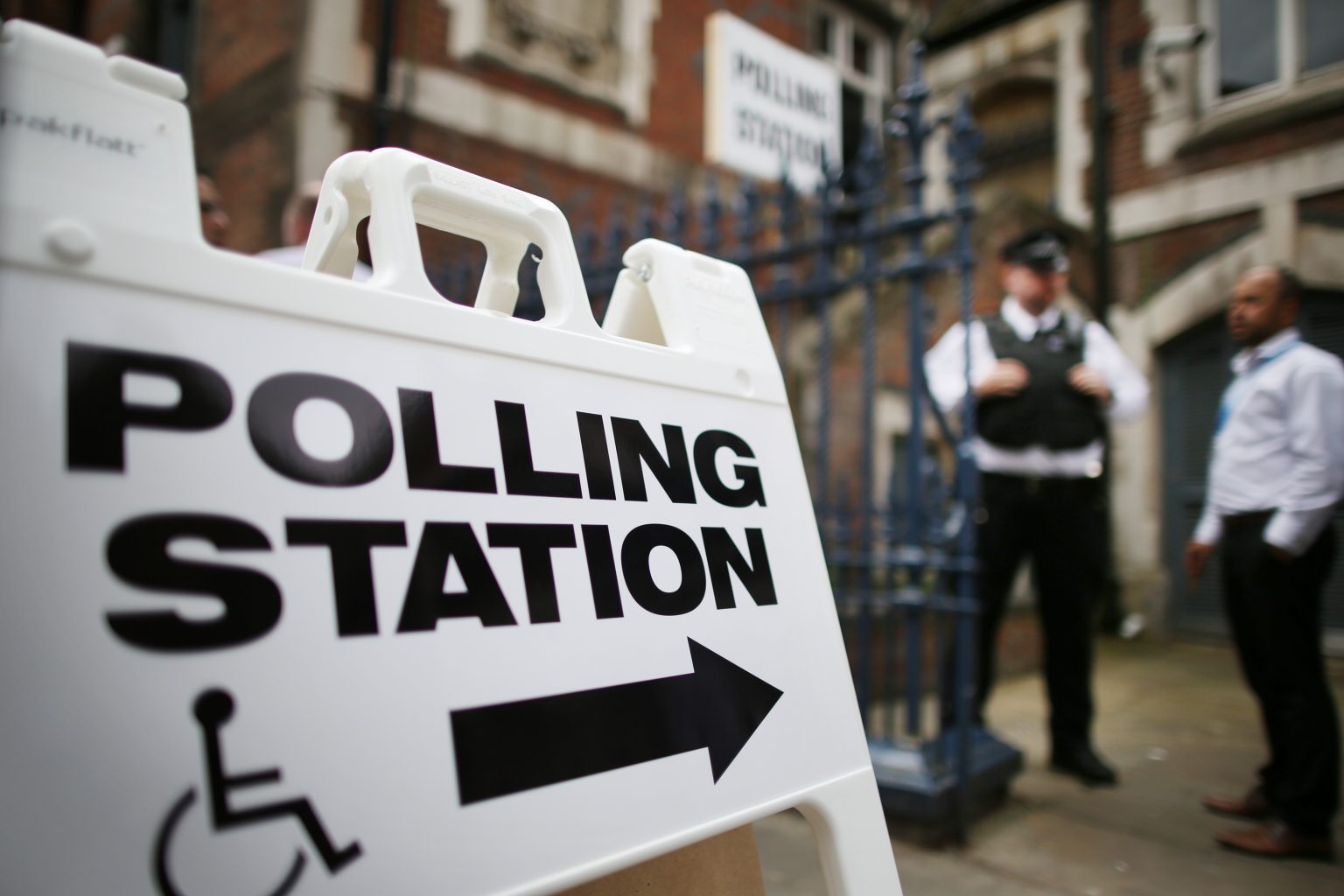
LONDON, UNITED KINGDOM - MAY 22: A policeman and an official stand outside a polling station at Christ Church Church of England Primary School in Brick Lane on May 22, 2014 in London, England. Millions of voters are going to the polls today in local and European elections. (Photo by Peter Macdiarmid/Getty Images)
Complex circumstances mean the 2022 local elections are unlikely to deliver the definitive coup de grace some are hoping for
Just a few short weeks ago it was being suggested that the outcome of the local elections on 5 May could determine Boris Johnson’s political fate – assuming he made it that far. Tory MPs concerned about the potential electoral damage caused by the partygate allegations looked as though they might move against the prime minister if their party was to suffer serious electoral losses at the ballot box.
After all, bad local election results have previously helped dislodge a prime minister. A bad Labour performance in 2006 resulted in growing pressure on Tony Blair to stand down, which he eventually did twelve months later. More recently, serious Conservative losses in 2019 added to the calls for Theresa May to resign in the wake of her inability to secure Commons’ support for her Brexit deal, a step which she duly took three weeks later after an even worse performance in subsequent European elections.
Following the Ukraine crisis, the storm surrounding the prime minister has abated – for the time being, at least. However, it is doubtful whether the local election ballot boxes would ever send a simple political message to which Tory MPs might feel impelled to respond.
Three key features of this year’s elections in England point to that conclusion. First, they take place disproportionately in places where Labour are already in command. Second, in many of the councils the Conservatives are defending, only one-third of the seats are up for grabs. Third, the Conservatives did not do particularly well when most of the seats in play were previously contested.
May’s local elections are a smorgasbord of complexity that opens up the prospect of every party being able to cherry pick those results that paint their performance in a positive light. The most straightforward contests are in London, where all of the 1,800 seats on the capital’s 32 borough councils are being contested. Moreover, because most wards elect three councillors rather than just one, a change of the front runner in just a few wards can result in a substantial change in a council’s political composition. However, the Conservatives are defending overall control in just seven boroughs, so there is not a lot for them at stake.
Outside the capital, partial elections prevail. In 94 councils, one-third of the seats are up for grabs (fought in single member contests), while in another six only half are at stake. Only on 14 councils are all the seats being contested, including those for four new single-tier councils in Cumbria, North Yorkshire and Somerset that will replace the existing two-tier structure locally.
But these predominantly rural areas are exceptions rather than the rule. Those councils with elections are disproportionately situated in more urban (and thus more Labour) England. Labour will be defending overall control of 41 councils, 26 of them large, single tier districts, while the Conservatives are currently in charge of 37, all but ten of them lower tier, relatively small district councils, and in only five of which are all the seats at stake. Overall, 2,500 seats are being fought over – just 700 more than in the capital.
There are, though, also elections for all the 1,200 seats on Scotland’s 32 local authorities, as well as for all 1,200 on the 22 councils in Wales. But neither set of elections is politically straightforward. In Scotland, the ballot will take place using the single transferable vote (STV) system of proportional representation. Consequently, there has to be a dramatic turnover in votes to occasion much in the way of a turnover in seats. Most councils will remain hung, as all but the three island (Independent-dominated) councils are at present, with the shape of the local administration determined by post-election bargaining.
In Wales, the elections are being conducted using first-past-the-post, albeit perhaps for the last time, following recent legislation that will allow councils to switch to STV in future. However, outside Cardiff party politics does not dominate. Even Labour fought only 70 per cent of the wards last time, while none of the other parties contested as many wards as did Independent candidates. As a result, the political message may well be patchy, and, in any event, the Conservatives are only defending control of one council, Monmouthshire.
Meanwhile, the outcome of any set of local elections depends above all on one key question – when were the seats at stake last contested? For the most part, the answer to that question in England – including throughout London – is four years ago, in 2018. The Conservatives were not then in an especially strong position. On average, the polls at the time put the party (41 per cent) just two points ahead of Labour (39 per cent), while the BBC’s estimate of what the parties’ local election performances implied for a general election put the two parties neck-and-neck, on 35 per cent each. The Conservatives are therefore not defending anything like as good a performance as the...
Subscribe to The Mace
Join the member community shaping British politics and stay ahead of
what's really happening in the world of politics and public affairs,
with expert analysis, breaking news, and insider insights from
Westminster and Brussels. The Mace is the leading news source and
resource for the government affairs industry, offering required
reading and lobby intelligence for professionals.
To see what you are missing out on by not subscribing to The Mace, click here to download our full membership info-pack. This includes
having no paywall on op-ed content or profiles/interviews, allowing
professional profiles to be read with maximum impact and visibility by
government, special advisers, MPs, peers, civil servants, and policy
and political decision-makers.